Biogas Purification: The Real Roles of Molecular Sieve,Activated Alumina and Silica Gel
2026-09-21
With the growing global demand for renewable natural gas, the biogas purification and upgrading market continues to expand. For biogas project operators, choosing the right adsorbent affects system efficiency, methane recovery, and long-term operating costs directly. This article examines the practical positioning of three adsorbent materials—molecular sieve, activated alumina, and silica gel—in biogas purification.
I. Core Challenges in Biogas Purification
Raw biogas contains impurities including moisture, carbon dioxide, hydrogen sulfide, siloxanes, nitrogen, and oxygen. Siloxanes burn to form silicon dioxide deposits that wear down engine components; moisture combined with acid gases forms corrosive solutions that shorten pipeline life. For grid-connected biomethane projects, strict specifications must also be met, such as methane purity ≥97% and water dew point ≤-10°C.
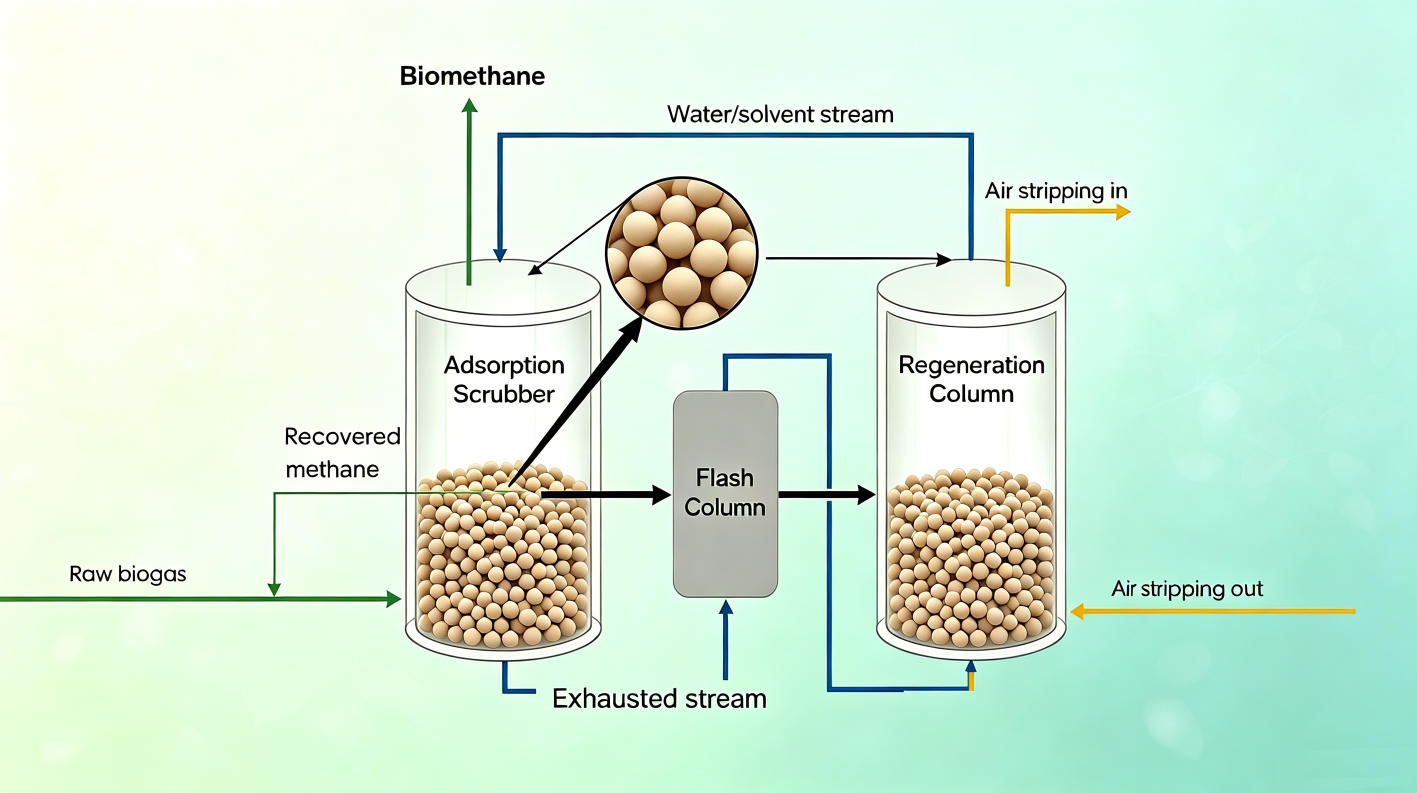
Adsorption is an important technical pathway for biogas purification due to its simple operation, good selectivity, and regenerability. However, the functional boundaries and engineering maturity of different adsorbent materials vary significantly and require objective assessment.
II. Product Positioning of Three Adsorbent Materials
Molecular Sieve
Primary role in biogas purification: Molecular sieve is mainly used for CO₂/CH₄ separation and deep dehydration in biogas purification. In pressure swing adsorption (PSA) biogas upgrading, molecular sieve is the core material for CO₂ separation. Both 5A and 13X molecular sieves can be used to remove CO₂ from biogas. Composite bed designs (such as 3A molecular sieve + 13X molecular sieve) can be used for deep dehydration of biogas. Molecular sieve also possesses a certain siloxane adsorption capacity.
Engineering application status: Molecular sieve has real applications in deep dehydration and PSA decarbonization in China. However, its CO₂ adsorption capacity is significantly affected by moisture, typically requiring upstream coarse dehydration.
Activated Alumina
Primary role in biogas purification: Activated alumina is mainly used for dehydration in biogas purification.
Engineering application status: Activated alumina has mature applications in dehydration, with good adsorption capacity, low regeneration temperature, and resistance to fracturing in liquid water. It is suitable for gas with low acid gas content. It should be clearly stated that activated alumina is not used for siloxane adsorption in Chinese biogas projects—the mainstream adsorbent for siloxane removal in China is activated carbon.
Silica Gel
Primary role in biogas purification: Silica gel is mainly used for dehydration in biogas purification, while also possessing a certain siloxane adsorption capacity.
Engineering application status: Silica gel is used as an economical dehydrating agent in biogas drying. Its limitations include: it tends to fracture after absorbing water, fails quickly at high throughput, and is suitable for low-moisture conditions. Moisture competition significantly reduces its siloxane adsorption efficiency. Therefore, in actual projects, the siloxane adsorption capacity of silica gel is underutilized, and its core role remains dehydration.
III. The Real Route for Siloxane Removal in China
It must be particularly noted that in Chinese biogas purification projects, the mainstream adsorbent for siloxane removal is activated carbon, not activated alumina or molecular sieve.
In Chinese engineering practice, using two-stage adsorption vessels with coal-based activated carbon adsorbent to treat siloxanes in landfill gas and biogas is a mature approach. Activated carbon adsorption is widely applied in China, with core advantages of maturity, low cost, and easy replacement. Overall, siloxane removal in China is still in the research and development stage, with limited large-scale engineering application cases.
IV. Adsorbent Configuration Strategies for Different Biogas Sources
Based on the above facts, adsorbent configuration should follow the principle of "adapting to the gas source and prioritizing mature solutions":
Agricultural Waste Biogas (Straw, Livestock Manure, etc.)
Feedstock characteristics: For biogas projects using agricultural waste such as straw and livestock manure, siloxane concentrations are typically at low levels and are not a major purification challenge. The core impurities are moisture, CO₂, and H2S.
Recommended configuration:
Dehydration: Silica gel or activated alumina as the primary dehydrating agent.
Desulfurization: Iron oxide-based adsorbents or impregnated activated carbon can be used.
CO₂ separation (if grid-connected): Molecular sieve handles CO₂/CH₄ separation in the PSA unit.
Whether a siloxane removal unit is needed: Whether to install a siloxane removal unit should be determined based on measured siloxane concentrations in the raw gas. It should not be a standard process for agricultural biogas projects.
Landfill Gas / Wastewater Treatment Plant Biogas
Feedstock characteristics: High siloxane content, which is the core challenge in purification.
Recommended configuration:
Siloxane removal: Chinese engineering practice recommends prioritizing activated carbon as the siloxane removal adsorbent, which is a proven and mature route.
Dehydration: Silica gel or activated alumina as upstream dehydration to protect downstream adsorbents from moisture competition.
CO₂ separation (if grid-connected): Molecular sieve handles CO₂/CH₄ separation in the PSA unit.
Grid-Connected Biomethane Projects
Core requirements: CO₂ separation and deep dehydration are essential. Molecular sieve is a mature choice in the PSA unit. Upstream dehydration must be configured to protect the molecular sieve. Whether to install a siloxane removal unit should be determined based on measured siloxane concentrations in the raw gas.
V. Conclusion
Molecular sieve, activated alumina, and silica gel each have clearly defined functional roles in biogas purification:
Molecular sieve: Has real applications in deep dehydration and PSA decarbonization, and is a conventional choice for grid-connected projects in China.
Activated alumina: Mainly used for dehydration, with low regeneration temperature and resistance to fracturing in liquid water, suitable for scenarios with low acid gas content. It is not used for siloxane adsorption.
Silica gel: Mature dehydration application, with a certain siloxane adsorption capacity, but due to moisture competition, its siloxane adsorption capacity is underutilized in actual projects.
For biogas project operators, the core principle of selection is: prioritize engineering-proven mature solutions. If your project involves siloxane removal, evaluate activated carbon solutions first; if it involves CO₂ separation and deep dehydration, molecular sieve is the more reliable choice; if dehydration is the primary need and the gas source has low acid gas content, both activated alumina and silica gel are mature options.
The key difference between agricultural waste biogas (straw, manure, etc.) and landfill gas/wastewater plant biogas lies in siloxane content. The former has low siloxane concentrations, with purification focused on dehydration and desulfurization; the latter has high siloxane content and must be equipped with a siloxane removal unit, for which the mature route in China is activated carbon adsorption. Selection should be tailored to the specific feedstock source rather than applying a uniform "three-adsorbent combination" formula.



 Tracy Chen