
Technical article
2026-06-23
In modern industrial separation and purification processes, molecular sieves play a crucial role in removing impurities, drying gases and liquids, and separating molecules based on size. Among various types of molecular sieves, 5A Molecular Sieve is one of the most widely used adsorbents due to its excellent adsorption capacity, selective pore structure, and outstanding thermal stability.
Industries such as petroleum refining, natural gas processing, oxygen production, hydrogen purification, refrigeration, and chemical manufacturing rely heavily on 5A molecular sieve technology to improve efficiency and product quality.
This comprehensive guide explains everything you need to know about 5A molecular sieve, including its composition, working principle, specifications, advantages, industrial applications, regeneration methods, and selection criteria.
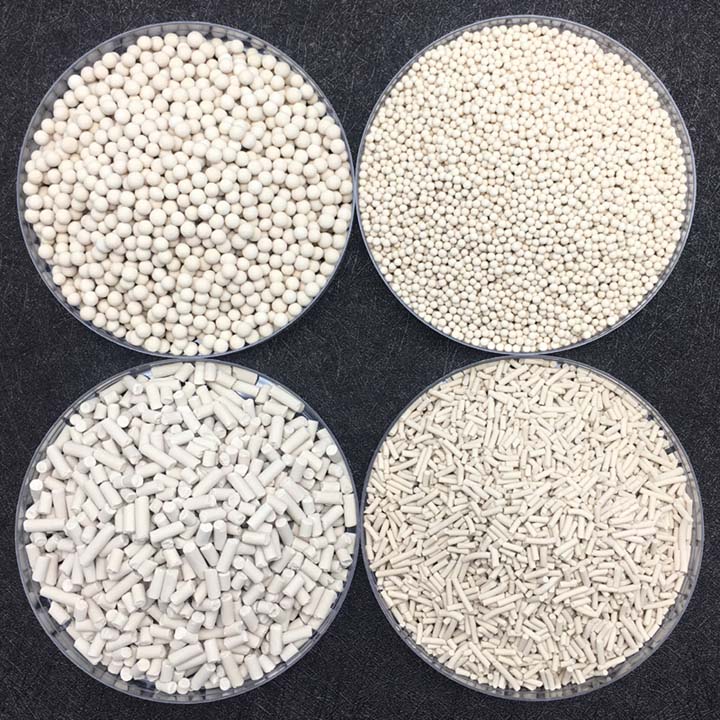
A 5A Molecular Sieve is a synthetic crystalline aluminosilicate material derived from Type A zeolite. It is produced by replacing sodium ions in a 4A molecular sieve structure with calcium ions.
The result is a pore opening of approximately:
5 Angstroms (0.5 nanometers)
This pore size allows the material to selectively adsorb molecules smaller than 5Å while excluding larger molecules.
The typical chemical formula is:
Ca₄.₅Na₃[(AlO₂)₁₂(SiO₂)₁₂] · xH₂O
The adsorption mechanism is based on:
Only molecules smaller than the pore diameter can enter the crystal structure.
Adsorbed molecules include:
Rejected molecules include:
Because of its ionic crystal structure, 5A molecular sieve exhibits strong attraction toward polar molecules such as:
The adsorption process is reversible.
After saturation, the molecular sieve can be regenerated through:
This allows multiple reuse cycles and lowers operational costs.
| Property | Value |
|---|---|
| Pore Size | 5Å |
| Shape | Beads or Pellets |
| Color | Beige |
| Bulk Density | 0.65–0.75 g/ml |
| Crush Strength | High |
| Water Adsorption | ≥21% |
| Regeneration Temperature | 200–350°C |
| Thermal Stability | Excellent |
| pH Stability | Good |
| Service Life | 3–5 years (typical) |
5A molecular sieve can remove trace moisture down to extremely low dew points.
Typical dew point:
This makes it ideal for gas drying applications.
The precisely controlled pore size enables separation based on molecular dimensions.
This selective adsorption improves process efficiency and product purity.
Industrial-grade 5A molecular sieves are designed to withstand:
Properly operated systems can maintain performance for several years.
Benefits include:
5A molecular sieve maintains its structure even under high regeneration temperatures.
This allows repeated adsorption-desorption cycles without significant degradation.
Common sizes:
Advantages:
Applications:
Common sizes:
Advantages:
Applications:
Natural gas often contains moisture that can cause:
5A molecular sieve effectively removes water vapor to achieve pipeline-quality gas.
Benefits:
Pressure Swing Adsorption (PSA) oxygen systems use molecular sieves to separate oxygen and nitrogen.
5A molecular sieve helps:
Applications:
Hydrogen production processes require removal of:
5A molecular sieve improves hydrogen purity for:
Compressed air contains moisture that may cause:
5A molecular sieve provides ultra-low dew point drying.
Applications include:
One of the most important uses of 5A molecular sieve is separating:
From:
This process is widely used in:
Refrigeration systems require extremely dry refrigerants.
5A molecular sieve removes:
Benefits:
Liquefied Natural Gas (LNG) facilities utilize 5A molecular sieve to remove:
Before cryogenic cooling.
This prevents:
Applicable gases include:
The molecular sieve removes contaminants that affect gas purity.
| Property | 3A | 5A |
|---|---|---|
| Pore Size | 3Å | 5Å |
| Water Adsorption | Excellent | Excellent |
| Hydrocarbon Adsorption | Limited | Strong |
| Refrigerant Drying | Excellent | Good |
| Natural Gas Drying | Moderate | Excellent |
| Paraffin Separation | No | Yes |
Choose 3A for:
Choose 5A for:
| Property | 5A | 13X |
|---|---|---|
| Pore Size | 5Å | 10Å |
| Selectivity | Higher | Lower |
| Water Capacity | High | Very High |
| Hydrocarbon Adsorption | Selective | Broad |
| Gas Purification | Excellent | Excellent |
5A is preferred when:
13X is preferred when:
Regeneration restores adsorption capacity after saturation.
Most common method.
Typical conditions:
Used in PSA systems.
Advantages:
Often applied in:
Benefits:
Higher inlet moisture leads to:
Lower temperatures generally improve adsorption capacity.
Higher temperatures reduce adsorption efficiency.
Increased pressure typically enhances adsorption performance.
Excessive flow rates can:
Proper bed design is essential.
Evaluate:
Different industries require different outlet specifications.
Examples:
Smaller particles:
Larger particles:
Ensure the selected product can withstand:
To maintain product quality:
Because molecular sieves rapidly absorb atmospheric moisture.
High-quality 5A molecular sieve products generally comply with:
Manufacturers often provide:
Achieves very deep drying levels.
Efficient impurity removal.
Separates molecules by size.
Reduced maintenance costs.
Multiple adsorption cycles.
Optimized performance in PSA and drying systems.
Demand for 5A molecular sieve continues to grow due to:
Global natural gas infrastructure requires advanced drying technologies.
Hydrogen purification applications are increasing worldwide.
Oxygen, nitrogen, and specialty gas markets continue expanding.
Stricter emission standards drive demand for efficient purification systems.
New energy industries require high-purity gases and reliable adsorption solutions.
5A molecular sieve is primarily used for natural gas drying, hydrogen purification, oxygen production, hydrocarbon separation, refrigerant drying, and industrial gas purification.
The “5A” refers to a pore opening of approximately 5 Angstroms (0.5 nanometers), allowing adsorption of molecules smaller than this size.
Yes. It can be regenerated using heat, pressure swing adsorption (PSA), or vacuum desorption methods.
Under proper operating conditions, industrial-grade 5A molecular sieve can typically last between 3 and 5 years.
Yes. It is widely used in LNG pretreatment systems to remove water and carbon dioxide before liquefaction.
4A molecular sieve has a 4Å pore size and is mainly used for drying applications, while 5A molecular sieve has a larger 5Å pore size and can separate normal paraffins from branched hydrocarbons.
Industries include:
5A Molecular Sieve remains one of the most important adsorbents used in industrial drying, purification, and molecular separation. Its unique 5-angstrom pore structure, high adsorption capacity, exceptional selectivity, and excellent regeneration performance make it indispensable in natural gas processing, hydrogen purification, oxygen generation, LNG production, and petrochemical applications.
As global demand for cleaner energy, high-purity industrial gases, and efficient processing technologies continues to rise, 5A molecular sieve will remain a critical component in modern adsorption systems. For companies seeking reliable gas drying and purification solutions, choosing high-quality 5A molecular sieve products can significantly improve operational efficiency, reduce costs, and enhance product quality.


 Tracy Chen