Molecular sieve 13X APG III for air separation equipment in steel plants
2026-08-27
As a pivotal steel giant in Africa, our client's cryogenic air separation units have been operating continuously for many years. However, with the erosion of time, the original molecular sieve 13X, activated alumina, and ceramic balls inside gradually show signs of fatigue - the penetration time of carbon dioxide is shortened, and regeneration switching is becoming more frequent. This not only increases energy consumption, but also makes the stability and safety margin of the entire oxygen production system light up yellow. Replacing adsorbents has become a difficult problem for steel mills: who to choose? Why trust new suppliers?
Our story began with an ice breaking event in April last year. At that time, the customer’s technical manager raised a series of sharp questions about core parameters, such as control of the regeneration environment, technical support, and bed mix design. We are well aware that in the face of such industry leaders, talking on paper is meaningless. With the rigor of chemical workers, we dismantled their concerns one by one. However, over the course of several months, there were divergent opinions among managers at various levels within the client - some preferred to use the original brand adsorbents, some were concerned about the adaptation risks after replacement, and some were skeptical about domestic alternatives. The negotiations were once deadlocked, and every email exchange felt like walking on a tightrope.
After in-depth discussions, our technical team compared and presented feedback data from multiple large-scale air separation projects we have supplied in China: our molecular sieve 13X APG III has a 20% higher water adsorption capacity than conventional molecular sieve 13X, a more than 25% increase in carbon dioxide adsorption capacity, and a crushing strength and wear rate not lower than branded molecular sieves - the customer's eyes began to light up.
In the following month, after several rounds of technical support, payment terms, and payment methods, the factory manager finally decided to try out a batch of our products first. After months of repeated argumentation and tug of war, it has finally come to a conclusion.
1、The role of three materials in the pre-purifier (SACIM)
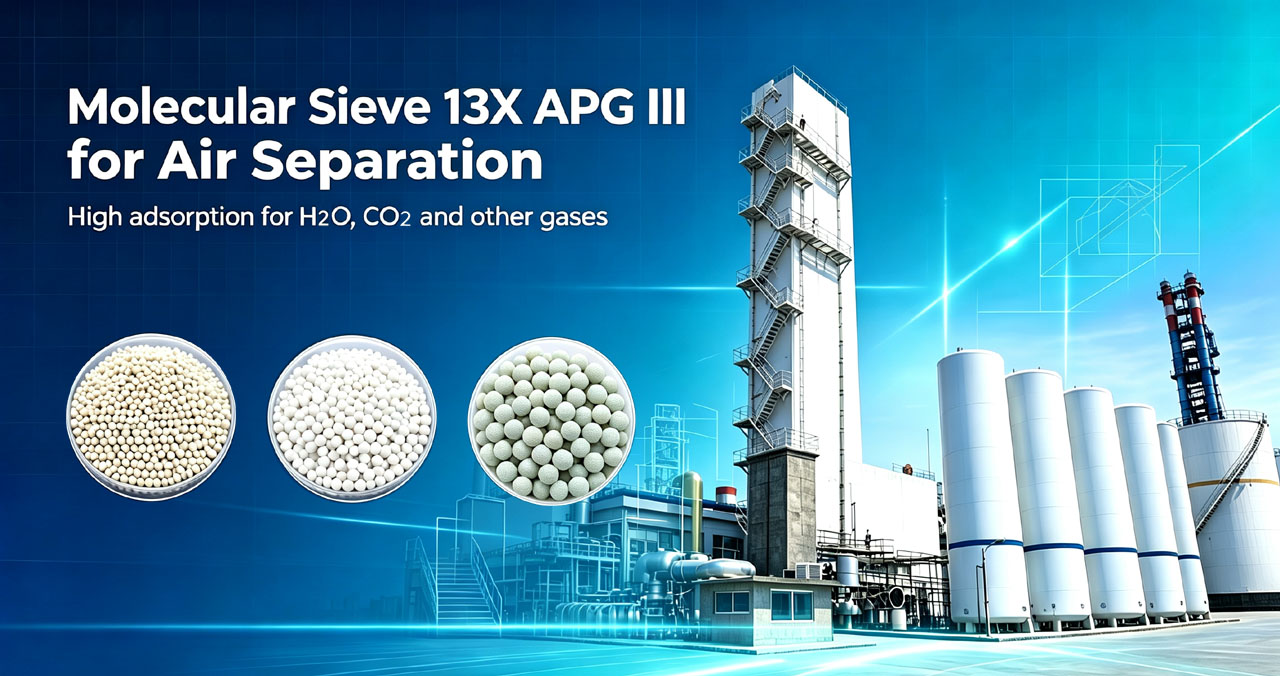
In the pre-purifier of the air separation unit, these three materials have clear division of labor, forming an efficient adsorption purification system. Usually, the equipment adopts a double-layer bed structure: the lower part is filled with ceramic balls and activated alumina, and the upper part is filled with 13X APG III molecular sieve.
|
Material |
Function |
Key Characteristic |
|
Ceramic Ball |
Airflow distribution and support media |
Fill the bottom of the purifier to support the adsorbent bed above, preventing it from collapsing or clogging. Can distribute the incoming airflow, avoid the impact and wear of adsorbents such as molecular sieves caused by high-speed airflow. |
|
Activated Alumina |
Efficient pre-water removal |
Remove moisture from compressed air (adsorbing over 20% of its own weight). Good water resistence with high strength, able to withstand the impact of liquid water, creating a dry environment for the subsequent deep purification of molecular sieve. |
|
Molecular sieve 13X APG III |
Deep purification |
High efficient adsorbent designed for air separation, mainly remove small amount of residual hydrocarbons such as H2O, CO2 and acetylene after treatment with activated alumina. |
2、Working principle
The working principles of these three materials are based on different physical and chemical mechanisms:
* Ceramic ball (physical action): Its action is entirely physical. Relying on its high strength and chemical inertness, it serves as a supporting medium and gas flow redistributor, without participating in any adsorption or chemical reactions.
* Activated alumina (physical adsorption): Utilizing its rich capillary structure, water molecules are physically adsorbed through van der Waals forces. It has good adsorption capacity for high moisture content and low adsorption heat, so it is used as the first water removal layer.
* Molecular sieve 13X APG III (chemical adsorption): This is an artificially synthesized aluminosilicate crystal with a uniform, 0.9 nanometer pore size.
1) Molecular sieving effect: Only molecules with a critical diameter less than 0.9 nanometers are allowed to enter their pore channels. The main components of air, nitrogen, oxygen, and argon (with kinetic diameters less than 0.9 nanometers), can freely pass through, while most impurity molecules can also enter the pores.
2) Polar adsorption: The molecular sieve skeleton is a strongly polar substance. Water molecules are strongly polar molecules, and carbon dioxide and acetylene also have high polarizability, so they are preferentially and firmly adsorbed by the strong electric field in the molecular sieve pore channels, while non-polar molecules such as nitrogen and oxygen are hardly adsorbed. Based on this characteristic, 13X APG III can deeply dry air to a dew point of at least -100 ℃.
3、The working and operation mode of pre-purifier (SACIM)
The air separation pre-purification system usually adopts a process of alternating operation of two adsorbers to ensure uninterrupted air purification process. Its core is the "adsorption regeneration" cycle:
1) Adsorption (working) stage
Compressed air from the air cooling tower (usually at around 13 ℃) first enters the bottom of the adsorber.
The airflow sequentially passes through the ceramic ball layer (uniformly distributed airflow) → the activated alumina layer (adsorbing most of the moisture) → the molecular sieve layer (deeply removing residual moisture, carbon dioxide, and hydrocarbons).
The purified clean air is sent out from the top of the adsorber and enters the subsequent heat exchanger and distillation tower for low-temperature separation.
2) Regeneration (desorption) stage
When one adsorber is saturated with adsorption (determined by detecting the carbon dioxide content), the system will automatically switch to another regenerated adsorber to continue working.
The saturated adsorber enters the regeneration process, which is the reverse process of adsorption. Usually, high-temperature polluted nitrogen gas (about 180-350 ℃) from the distillation tower is introduced from the top of the adsorber.
High temperature allows the adsorbed water and impurities such as carbon dioxide to obtain sufficient energy, desorb from the micropores of the adsorbent, and be carried away by the polluted nitrogen flow.
After regeneration is completed, cool the adsorber to operating temperature with cold polluted nitrogen gas and prepare for the next switch.
Now the entire batch of adsorbents has been successfully shipped last year, and we received new request for the replacement of activated alumina this year. For OIM Chemical, every trust from global customers is the best feedback for 15 years of focusing on the adsorbent field.



 Tracy Chen