Adsorbents for some main industrial application
2026-10-28
Scenario 1: Natural Gas Dehydration
The most commonly used molecular sieve type for deep dehydration of natural gas is 3A type (potassium type A crystal structure), with a pore size of about 3 Å, allowing only water molecules (dynamic diameter of about 2.75 Å) to enter, blocking methane, CO2, H2S, etc. outside the pores. In the experimental data, the particle size of 3A molecular sieve is 3.0-5.0 mm, and the water adsorption capacity is about 20 wt% at 25 ℃ and 45 mbar. The recommended regeneration temperature is 200-230 ℃. If both CO2 and H2S need to be removed from natural gas, 4A type (pore size 4 Å) or 13X type (pore size 10 Å) can be selected, but molecular sieve 3A has the best selectivity in deep dehydration scenarios.
Typical filling sequence for natural gas dehydration tower: 100-200mm ceramic balls are laid at the bottom of the tower (serving as inert support and airflow distribution) → activated alumina is installed at the inlet end (with compressive strength higher than molecular sieve, bearing most of the water load and resisting liquid water impact) → 3A molecular sieve is installed at the outlet end (with deep precision dehydration to dew point below -76 ℃). The advantage of activated alumina lies in its lower regeneration temperature (complete regeneration can be achieved at 175-200 ℃), while the regeneration temperature of molecular sieves is higher. Layered design allows alumina to bear the coarse removal load and molecular sieves to focus on fine removal, reducing overall regeneration energy consumption.
There are industrial cases showing that after replacing the adsorbent with 5mm activated alumina in the natural gas dehydration tower, the performance remains stable after 12 months of operation, and the regeneration energy consumption is reduced by about 5%. In addition, for small dehydration units of natural gas instrument gas or fuel gas, mature products use activated alumina to achieve a water dew point of -40 ℃ at 100 PSI and 150 scfm conditions, which can be used as a reference benchmark for levered natural gas dehydration schemes.
In summary, for natural gas to be liquefied or transported through pipelines, the dew point must be lowered to below -76 ℃, and 3A molecular sieve is the last step; The front-end uses activated alumina for coarse dehydration, which can help customers save energy on regeneration.
Scenario 2: Compressed Air Dryer
The most mainstream filling scheme in compressed air adsorption dryers is to use activated alumina as a base and molecular sieve as a finishing material. Typical parameters of activated alumina: spherical particles, commonly used in sizes of 1/8 "(3.2 mm), 3/16" (4.7 mm), and 1/4 "(6.4 mm), with a specific surface area>300 m ²/g and a bulk density of approximately 680-750 kg/m ³. These specification data directly correspond to the loading design of the dryer manufacturer.
Molecular sieve 4A are commonly used in compressed air drying (pore size 4 Å, capable of absorbing water and adsorbing some CO2). If the pressure dew point is required to reach -70 ℃, the end must be refined with molecular sieves, and activated alumina alone cannot achieve this depth.
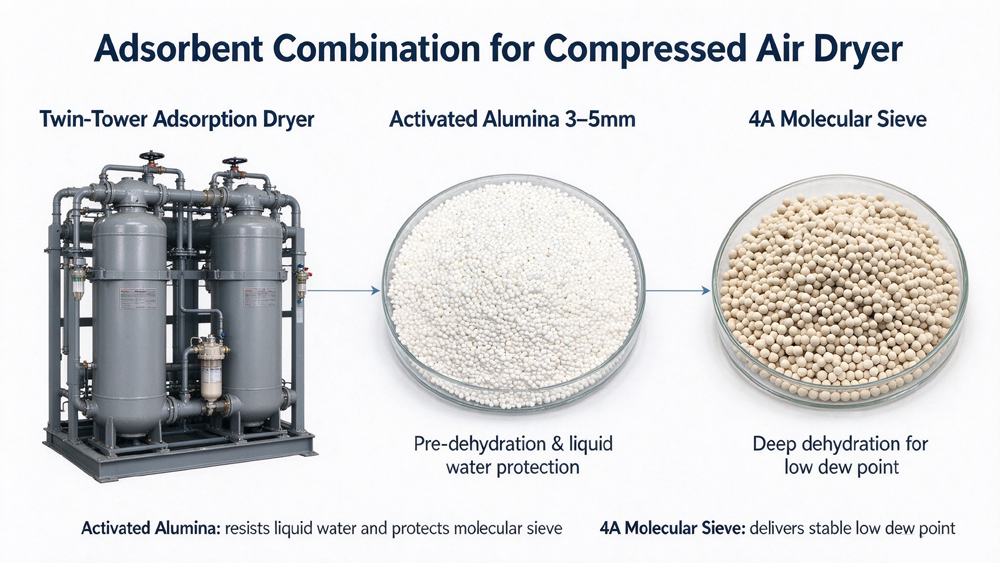
The function and specification selection of ceramic balls
Ceramic balls are placed at the bottom of the drying tower to support the upper layer of adsorbent, intercept rust and oil droplets, and evenly distribute air intake. The selection principle is generally that the diameter of the ceramic ball is about twice the particle size of the adjacent adsorbent, with a smaller ceramic ball of 3mm for the layer near the adsorbent and a larger ceramic ball of 6mm for the outer layer. The ceramic ball itself is chemically inert and has a low water absorption rate (about 3%), and will not react with oil and water in compressed air, which is equivalent to using low-cost materials to protect high-value activated alumina and molecular sieves.
High quality activated alumina can achieve a pressure dew point of -40 ℃ ~ -70 ℃ in compressed air dryers, with a service life of 2-3 years under normal design conditions. Its low dust characteristics can reduce post filter clogging. Parker's TW series heatless regeneration dryer is also filled with activated alumina as the standard, with a nominal pressure dew point of -40 ℃.
In summary, our company can provide a complete set of layered solutions including inert ceramic ball bottom protection, activated alumina coarse removal to -40 ℃, and molecular sieve fine removal to -70 ℃.
Scenario 3: PSA Nitrogen Generator
The common specifications of carbon molecular sieves (CMS) are classified according to their nitrogen production capacity and are usually named as CMS-240, CMS-260, CMS280, CMS-330, etc. Such as CMS-260: the adsorption pressure is 0.7-0.8 MPa, and the nitrogen production capacity is about 260 Nm ³/h.t at a nitrogen purity of 99.5%; Particle diameters can be 1.0-1.2mm, 1.5-1.7mm, and 1.6-2.0mm are optional, with a compressive strength of approximately 35-100N/pcs and a bulk density of 660-700 g/L. The nitrogen production capacity of CMS-260 and CMS-330 is higher in order, and customers can select the corresponding brand according to purity and gas volume requirements.
Carbon molecular sieves are extremely sensitive to oil and liquid water in compressed air. The inlet of the PSA nitrogen generator must undergo pre-treatment of oil removal, water removal, and dust removal, with a pressure typically ranging from 0.7 to 0.8 MPa and a temperature close to market temperature. Once the intake is contaminated with oil, the separation performance of CMS micropores irreversibly decreases after being blocked. Therefore, when targeting customers with integrated units of "air compressor + nitrogen generator", desiccant activated alumina and ceramic balls can be packaged together as a pre-protection solution for CMS.
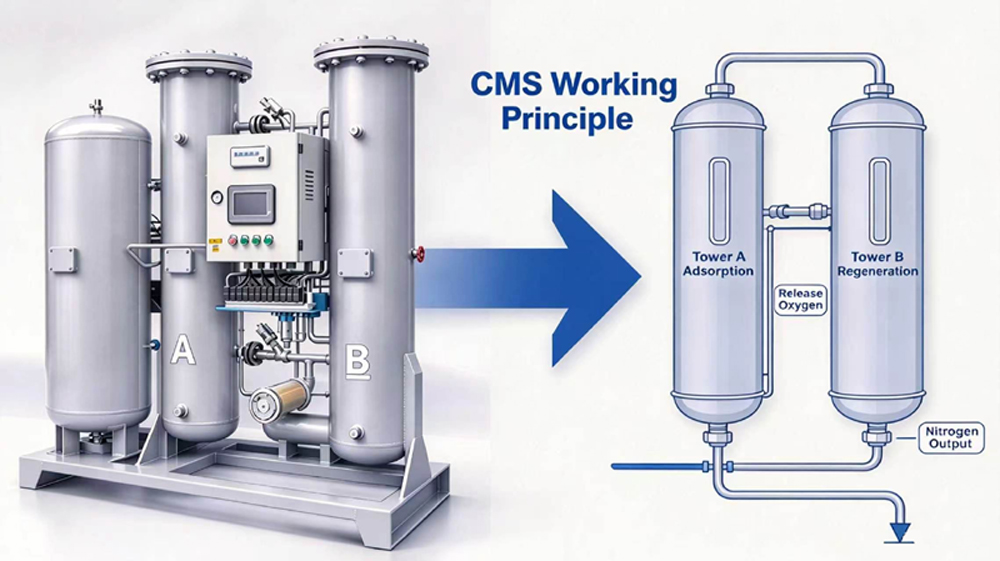
Commercial PSA nitrogen production units (such as the OZEN OANG-PRO series) are clearly labeled to use carbon molecular sieves with a pore size of approximately 3Å, with a lifespan of over 6~8 years under appropriate usage conditions and a purity coverage of 95% to 99.999%. This shelf time data can serve as a reference for CMS quality positioning - provided that the pre oil and water removal are done properly.
In summary, if you short the compressor with PSA nitrogen production, our company provides carbon molecular sieves and activated alumina, but it is recommended to equip it with drying and oil removal equipment, otherwise even the best performance of carbon molecular sieves cannot last for 2-3 years.
Scenario 4: Refrigeration compressor system (molecular sieve drying filter)
The most effective adsorbent in the drying filter of the refrigeration system is molecular sieve, which has a water absorption capacity 3-4 times that of other commonly used adsorbents. Industry recommended ratio: molecular sieve minimum 70%, activated alumina maximum 30% (weight ratio). Molecular sieves are responsible for deep dehydration, while activated alumina is responsible for adsorbing organic acids and oil degradation products. The combination of the two covers 2 types of problems in refrigeration systems: moisture and acidic pollutants. The specific molecular sieve model is mainly molecular sieve 3A (only absorbs water, does not adsorb refrigerant molecules), and some systems also use zeolite 4A. In refrigerant systems containing R-32 such as R-410A, the compatibility between the molecular sieve and R-32 needs to be confirmed. Tests have shown that after aging at 160 ℉ for 14 days, the fluoride ion content of the refrigerant is less than 0.2 ppm and the POE oleic acid value is less than 0.1, indicating that the compatibility is qualified.
Typical working conditions for refrigeration and drying filters: Suitable refrigerants include HCFCs, HFC, and lubricating oil POE/PAG. The working temperature is -40 ℃~ 120 ℃, and the maximum working pressure can reach 45 bar (some models have 67.5 bar). We have a customer who uses a 100% 3A molecular sieve dry filter with a filtration accuracy of 40 μ m for liquid tube drying and impurity interception.
In summary, the refrigeration compressor drying filter has a small volume and high requirements. The compound solution of 70% molecular sieve + 30% activated alumina is a mature industry practice, and our company can provide both adsorbents.
|
Application |
Adsorbent types |
Key scenario |
Key function |
|
Natural gas dehydration |
3A + AA |
Regeneration 200~230℃,dew point ≤-76℃ |
Molecular sieve refined dew point protection, alumina crude removal saves energy consumption |
|
Air compressor dryer |
AA+4A/3A +CBS |
0.7~1.0 MPa,dew point -40℃~-70℃ |
Ceramic ball support media, activated alumina as coarse removal and molecular sieve fine removal |
|
PSA Nitrogen Generator |
CMS |
0.7~0.8 MPa,N2 purity 99.5% in 240-330Nm³/h·t |
Core adsorbents for PSA N2 generator by air compressor |
|
Refrigeration compressor system |
3A + AA (7:3) |
-40~120℃,45 bar |
Deep dehydration and acidic pollutants removal |
Scenario 5: General Gas Drying
The gas drying covers industrial gases other than natural gas, refinery gas, hydrogen, and air, with the core requirement of lowering the dew point to an extremely low level (ppm level).
4A molecular sieve is common used in deep gas drying. Static water adsorption ≥ 22%, bulk density ≥ 0.66 g/ml, compressive strength bar ≥ 30 N/cm, spherical ≥ 35-90 N/particle, suitable for deep drying of gases and liquids such as air, natural gas, alkanes, refrigerants, etc. If the gas contains acidic components such as CO2 and H2S that require co adsorption, 13X molecular sieve (pore size 10 Å) with static water adsorption of ≥ 25% can be used for simultaneous dehydration and desulfurization/decarbonization.
The industrial testing from Brazil's pre-salt oil field FPSO is worth paying attention to: A natural gas dehydration unit with a processing capacity of over 6 MMSCMD uses activated alumina as the main adsorbent, and after the first regeneration, it stably produces dry gas with a water content of<1 ppm - previously thought to be achievable only by molecular sieves. The test also found that the recommended regeneration temperature for activated alumina is lower than that of molecular sieves, and the energy consumption and corresponding CO2 emissions of electric heaters are lower.
In summary, gas drying is not just using molecular sieves. The activated alumina has already achieved measured data of<1 ppm on large FPSOs, and the regeneration temperature is lower than molecular sieves, helping customers save electricity costs.
Scenario 6: Oil and gas purification
Honest speaking, "oil and gas purification" in the context of adsorbents consists of two layers: deacidification components (H2S, CO2, thiols) and dehydrogenation of heavy hydrocarbons (C6 ⁺). Both are often completed in the same composite bed layer as dehydration.
Deacidification component: Is it molecular sieve 3A or 4A?
There is a classic selection trap for the dehydration of sulfur-containing natural gas: 3A molecular sieve does not adsorb H2S, so it will not release high concentrations of H2S during regeneration, causing the problem of "H2S peak". Traditional designs tend to choose 3A. However, if designed properly, 4A molecular sieve can also be used for sulfur-containing gas dehydration - some studies have proposed to alleviate the H2S peak by changing the adsorption period (extending the adsorption time to allow H2S to be replaced and desorbed by subsequent water molecules in the bed), while reducing the investment in the molecular sieve unit and the operating cost of the regeneration system. If the customer's gas requires both dehydration and desulfurization, molecular sieve 13X is a more direct choice with a pore size of 10 Å, which can simultaneously adsorb H2O, CO2, H2S, and thiols.
In LNG pretreatment, the composite bed of the drying tower can be simultaneously filled with dehydration adsorbent (3A/4A molecular sieve or activated alumina) and heavy hydrocarbon adsorbent (activated carbon or water-resistant silica gel). A design indicator that can be cited is that after treatment with a composite bed, the moisture is removed to a dew point of ≤ -76 ℃ at atmospheric pressure, and the heavy hydrocarbons above C6 are removed to ≤ 217 ppm (preferably ≤ 10 ppm). The value of this "dehydration+heavy hydrocarbon removal" integrated solution lies in reducing equipment investment and later energy consumption, and the regenerated gas can be directly taken from the process gas without the need for external pure gas supply.
In summary, for sulfur-containing gas dehydration, molecular sieve 3A does not touch H2S, molecular sieve 4A controls peak value through periodic design, and molecular sieve 13X undergoes one-step dehydration and desulfurization. We have corresponding products for all three routes; Our company can also provide composite beds of ceramic balls, activated alumina, and molecular sieves for LNG customers who need to remove heavy hydrocarbons.
Scenario 7: Solvent Deep Dehydration
This is the direction of relative differentiation in the product line - customers are not gas processors, but solvent refining or recycling users in the chemical, pharmaceutical, and electronic materials fields. The core demand is to increase the water content in organic solvents from a few percent to ppm or even electronic level (<0.02%).
Mainstream solution: molecular sieve fixed bed
An industrial dehydration process that can be cited comes from a Chinese patent: the organic solvent is cooled to 5-30 ℃ (preferably 15-25 ℃) and then enters the molecular sieve drying tower for cyclic dehydration. In the first stage, the solvent moisture content is reduced to 0.10%~0.05%, and in the second stage, it is switched to another tower to continue the dehydration process to below 300 ppm or even below 30 ppm. The system adopts multi tower parallel rotation, and is purged with heated nitrogen gas for regeneration. The practical value of this case lies in providing three key parameters: temperature window, segmentation target, and regeneration medium. Customers can directly compare their solvent system to determine its suitability.
3A or 4A molecular sieves are usually selected for solvent deep dehydration. Molecular sieve 3A only absorbs water and does not adsorb solvent molecules (especially suitable for small molecule solvents such as alcohols and ketones), while 4A has slightly higher water absorption capacity but may adsorb other components in some solvents. If the customer is doing azeotropic separation (such as ethanol water), the new generation solution uses CHA structured small pore zeolite (pore size 0.38 nm × 0.38 nm, such as SSZ-13 or SAPO-34), which can achieve a dehydration rate of 18%~45% under vacuum pressure conditions at 80-90 ℃, and a saturated adsorption capacity of 16%~33% at room temperature and pressure.
In summary: solvent dehydration, 3A dehydration without touching the solvent, multi tower rotation can pull water to the 30 ppm level; If the customer is doing azeotropic separation, small pore zeolite is an upgrade option.
|
Application |
Adsorbent types |
Key scenario |
Key function |
|
Gas drying |
4A/13X + AA |
Pressure up to 100 atm, water content<0.1~1 ppm |
Activated alumina saves regeneration energy, molecular sieve maintains maximum dew point |
|
Gas and oil purification |
3A/4A/13X + AC/SG bed |
Dew point ≤ -76℃,C6+ ≤217 ppm |
3A can not adsorb H2S,13X remove H2S and CO2 |
Solvent Deep Dehydration
|
3A or 4A |
Adsorption at 5~30℃,segmented desorption to 30-300 ppm |
3A only adsorb H2O does not touch solvents |



 Tracy Chen