Adsorbents for Compressed Air Dryers
2026-10-08
Compressed air is a fundamental utility across manufacturing, pneumatic automation, pharmaceutical, food & beverage, and instrumentation industries. Water vapour trapped in compressed air systems leads to pipeline corrosion, blockages in control valves, instrument malfunction and end-product contamination. Regenerative compressed air dryers work on Pressure Swing Adsorption (PSA) principle, where solid adsorbents capture moisture to deliver low dew point dry air. The two most widely used adsorbent media for PSA dryers are activated alumina and molecular sieve. Correct selection directly impacts dryer stability, pressure dew point performance and service life.
Activated Alumina for Compressed Air Dryers
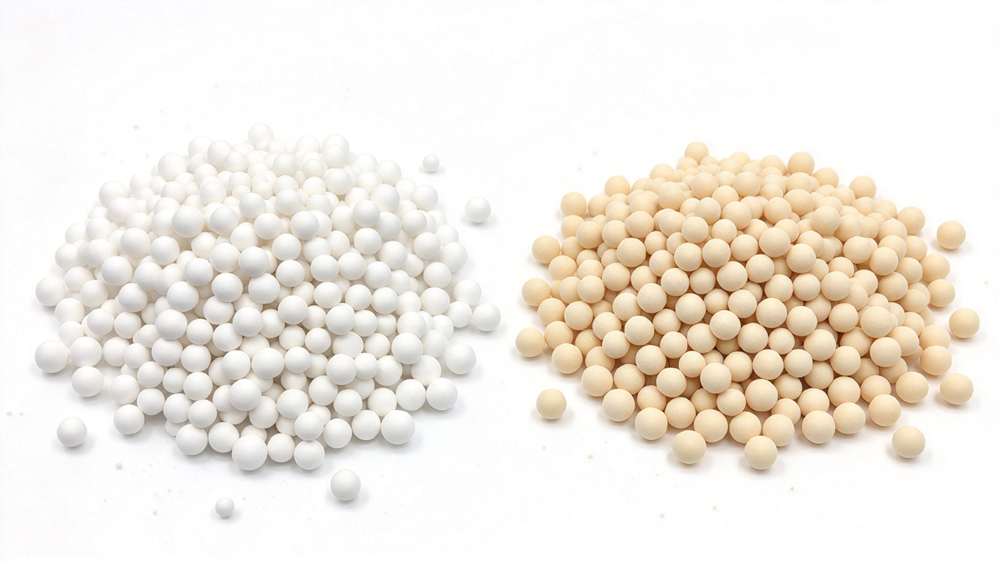
Activated alumina is the workhorse adsorbent for heatless and heated regenerative compressed air dryers, widely adopted in Europe, Southeast Asia and South America for general industrial compressed air drying.
· Typical pressure dew point: -40°C
· Core advantages: High crush strength, excellent resistance to occasional liquid water carry-over, low tendency to powder under frequent pressure cycling, cost-effective for standard drying requirements.
· Application scenarios: General workshop compressed air, heavy-duty heatless PSA dryers, systems with risk of condensate water entrainment.
· Key benefit for end users: Tolerates minor process upsets, reducing unexpected downtime for manufacturing plants.
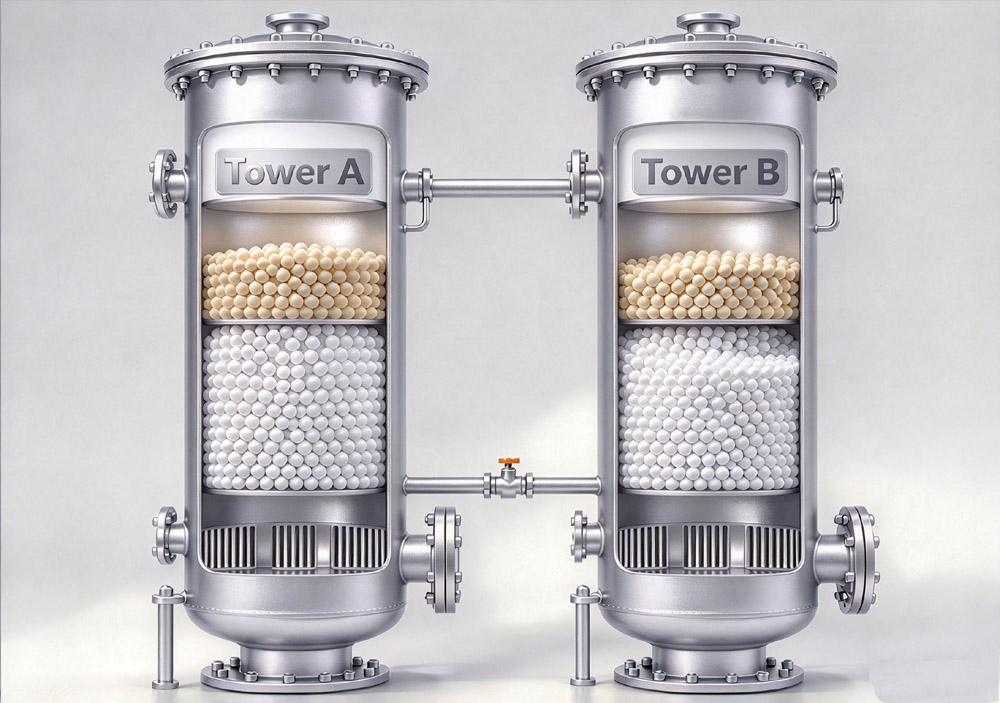
Activated alumina is commonly loaded as a protective bottom bed in layered adsorbent towers, shielding molecular sieve from liquid water damage.
Molecular Sieve for Compressed Air Dryers
Molecular sieve features uniform, precisely sized micropores, enabling selective adsorption of water molecules even at very low moisture concentrations. It is the preferred media when ultra-dry compressed air is required.
· Typical pressure dew point: down to -70°C
· Core advantages: Superior water adsorption capacity at low partial pressure of water vapour, achieves ultra-low dew points that activated alumina cannot reach.
· Limitations: Sensitive to liquid water ingress; liquid condensate will permanently damage the molecular sieve beads and cause heavy powdering. Higher material cost compared to activated alumina.
· Application scenarios: Electronics manufacturing, precision instruments, special gas drying, coating lines, and processes requiring ultra-dry compressed air.
· Recommended practice: Always use activated alumina as a pre-bed protection layer upstream of molecular sieve.
How to Choose Between Activated Alumina and Molecular Sieve
1. Target pressure dew point For standard industrial needs down to -40°C: activated alumina is the economical and reliable choice. For applications requiring dew points below -60°C: molecular sieve is mandatory. A dual-layer bed (activated alumina bottom + molecular sieve top) is the most popular engineering solution.
2. Dryer type: Heatless PSA / Heated regenerative dryer Heatless PSA dryers have rapid pressure switching cycles. Adsorbents must have high mechanical strength to resist abrasion and powder generation. Activated alumina performs very well here. Molecular sieve requires careful bed design and pre-filtration protection.
3. Risk of liquid water carry-over If your compressed air system has a high chance of condensate droplets, never use molecular sieve alone. Activated alumina acts as a buffer layer to catch liquid water before it reaches the molecular sieve layer.
4. Operating temperature and regeneration conditions Heated regenerative dryers require adsorbents with stable performance under high regeneration temperature. Both activated alumina and molecular sieve are suitable, but molecular sieve needs stricter temperature control during regeneration.
Performance Data Comparison: Activated Alumina vs Molecular Sieve
Adsorption capacity, bed service life and abrasion resistance are the three most critical metrics when selecting adsorbents for PSA compressed air dryers. The data below comes from long-term industrial PSA dryer field tests under typical operating conditions: inlet pressure 7 bar, inlet temperature 35°C, cycle time 4–10 minutes.
1. Water adsorption capacity At high water partial pressure (inlet dew point +15°C ~ +20°C): activated alumina delivers 6–8 wt% water uptake. At low water partial pressure (inlet dew point below 0°C). Molecular sieve shows far better performance, reaching 12–16 wt% water uptake, while activated alumina drops to only 3–4 wt%. This explains why molecular sieve can achieve ultra-low outlet dew points below -60°C, where activated alumina reaches its adsorption limit.
2. Abrasion rate & service life in PSA dryers Activated alumina beads: abrasion loss ≤0.3% after 200,000 pressure swing cycles. Typical service life ranges from 3 to 5 years in well-maintained dryers with proper pre-filter protection. Molecular sieve beads: abrasion loss ≤0.5% under the same PSA cycles. Typical service life ranges from 2 to 4 years. Molecular sieve service life drops sharply to 6–12 months if liquid water enters the adsorption bed. Liquid water ingress is the #1 factor that shortens molecular sieve lifespan, far more impactful than normal pressure cycling.
3. Pressure drop reference for common particle sizes Common bead sizes are 3–5 mm and 4–6 mm.
· 3–5 mm beads: higher contact area, higher pressure drop (~0.08–0.12 bar per meter bed height)
· 4–6 mm beads: lower pressure drop (~0.04–0.07 bar per meter bed height), preferred for large flow dryers. Smaller particles improve adsorption efficiency but increase energy consumption due to higher system pressure drop.
Common Adsorbent Failure Symptoms
Most PSA dryer performance issues are caused by degraded adsorbent rather than valve or controller faults. Plan adsorbent replacement when you notice:
· Gradually rising outlet pressure dew point that fails to meet design specification
· Excessive fine dust discharging from downstream filters
· Increased pressure drop across the adsorption tower
· Broken beads, bed voiding and channeling inside the tower
Oil aerosols from air compressors are one of the biggest causes of permanent adsorbent deactivation. Proper pre-filtration and oil removal filters can greatly extend the service life of activated alumina and molecular sieve.
Adsorbent Loading Best Practices
1. Fully clean the adsorption tower and remove residual old adsorbent powder before filling new media.
2. Fill beads evenly to avoid air channeling, which ruins drying efficiency.
3. For dual-layer beds: load activated alumina at the bottom for water protection, then molecular sieve on top.
4. Ceramic balls are recommended as supporting media at the tower base to reduce flow impact and protect adsorbent beads.
FAQ about Compressed Air Dryer Adsorbents
Q1: Can I mix activated alumina and molecular sieve beads together in one layer?
A: No. Mixed beads cause uneven air flow and channeling. The correct engineering design is a layered bed: activated alumina at the bottom, molecular sieve on the upper layer.
Q2: What is the main cause of molecular sieve powdering in PSA dryers? A: Liquid water shock is the primary cause, followed by high abrasion from repeated pressure switching without proper bed support and pre-filtration.
Q3: How often should adsorbents be replaced in a regenerative compressed air dryer?
A: Activated alumina normally lasts 3–5 years with good maintenance. Molecular sieve lasts 2–4 years. Replace early if liquid water or oil contamination occurs.
Q4: What particle size of activated alumina and molecular sieve is most common for PSA dryers?
A: 3–5 mm and 4–6 mm spherical beads are the standard sizes for regenerative compressed air dryers.
Conclusion
Activated alumina and molecular sieve dominate the adsorbent market for regenerative compressed air dryers. Activated alumina offers robust performance and cost savings for standard drying, while molecular sieve delivers ultra-low dew points for high-spec industrial processes. Many European, South American and Southeast Asian plants adopt a combined two-layer bed design to balance performance and service life.
Our company supplies high-quality activated alumina and molecular sieve beads for PSA compressed air dryers. Customized particle sizes and full technical datasheets (TDS) are available for dryer OEMs, system integrators and end-user projects. Contact our technical team for adsorbent recommendation based on your dryer model, flow rate and required dew point.



 Tracy Chen