The difference between CMS300 and CMS330 Carbon Molecular Sieve
2026-10-19
Carbon Molecular Sieve (CMS) based PSA (Pressure Swing Adsorption) nitrogen generation has become a dominant on-site gas supply solution across global industries. The core competitiveness of carbon molecular sieve lies not in a single extreme index, but in the precise control of micropore size distribution, pellet mechanical strength, stability over thousands of adsorption-regeneration cycles, balanced nitrogen output and air-to-nitrogen ratio.
CMS300 and CMS330 are high-grade domestic carbon molecular sieve grades, developed on the basis of conventional carbon molecular sieve CMS240 or CMS260 through optimized carbonization and micropore etching processes. These two grades have clear positioning gradients to match different requirements for nitrogen purity, gas output and energy consumption. They are widely adopted in lithium battery production, metal heat treatment, laser cutting, chemical inerting and electronic SMT industries.
A common misconception among many buyers is that Carbon molecular sieve CMS330 outperforms CMS300 under all working conditions. In fact, CMS330 delivers better nitrogen productivity at high purity ranges, but it is not always the preferred option for every project. CMS300 offers balanced overall performance in medium-to-high purity scenarios with higher tolerance to PSA system design. Now we will analyzes the technical features of CMS300 and CMS330 from microscopic mechanism, measured performance limits, working condition adaptability and long-term stability to help equipment manufacturers and end users make informed material selection.
1. Fundamental Principle of Kinetic Air Separation for Carbon Molecular Sieve
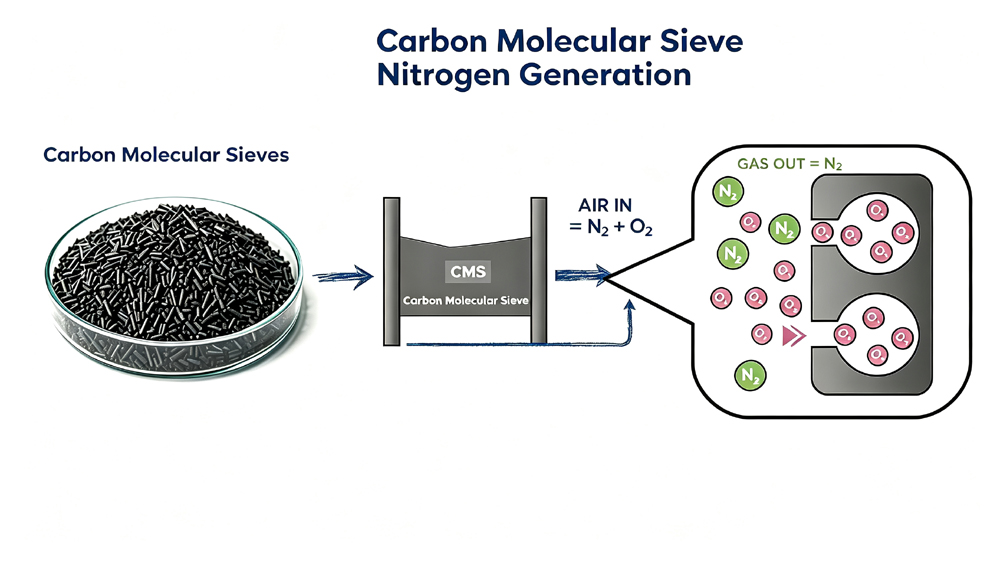
Carbon molecular sieve appears as black extruded cylindrical pellets, mainly composed of amorphous carbon with abundant controllable micropore channels inside. The kinetic diameter of oxygen molecule is 0.346 nm, while nitrogen molecule is 0.364 nm. The size difference is extremely small. Carbon molecular sieve separates oxygen and nitrogen relying on kinetic adsorption rate difference, rather than static selective adsorption.
Under PSA adsorption pressure, oxygen molecules diffuse rapidly into micropores and get adsorbed. Nitrogen molecules are slightly larger and diffuse much slower into the micropores, therefore enriched in gas phase to obtain product nitrogen gas. Once the adsorption sites are saturated, pressure reduction (desorption) releases oxygen trapped inside micropores, regenerating the carbon molecular sieve. Two adsorption towers work alternately in cycles to continuously produce nitrogen.
The separation performance heavily depends on precise micropore tuning. Over-sized micropores allow both oxygen and nitrogen to pass through and lose separation capacity. Too small micropores hinder oxygen adsorption and reduce nitrogen yield drastically. The key technical difference between CMS300 and CMS330 comes from refined adjustment of micropore size distribution, together with optimized pellet compressive strength to mitigate powdering risk during long cycles. Pellet powdering will cause increased bed pressure drop and channeling inside adsorption tower, which is the most common failure mode in industrial PSA plants.
Important note: All performance parameters are tested under standard conditions -- adsorption pressure 0.7 MPa, inlet air temperature 20°C, standard PSA cycle (2×40s). Actual performance will fluctuate subject to site conditions such as inlet air dew point, tower design and filling method. All figures are reference data from laboratory tests, not guaranteed for every field application.
2. CMS300 Carbon Molecular Sieve: Technical Features & Performance Boundaries
CMS300 is a high-performance general-grade carbon molecular sieve. It is engineered to balance nitrogen productivity, stability and energy consumption. Its narrow micropore distribution balances oxygen adsorption rate and structural stability, with better tolerance for PSA nitrogen generator design.
Core Technical Data (Standard condition 0.7MPa)
· Pellet size: Φ1.0~1.2mm cylindrical pellet; Bulk density: 650~690 kg/m³; Single pellet crush strength ≥35 N
· Nitrogen productivity:
· 99.5% N₂ purity: ~300 Nm³/h·t, air-to-nitrogen ratio approx.3.1
· 99.9% N₂ purity: ~190 Nm³/h·t, air-to-nitrogen ratio approx.3.7
· 99.99% N₂ purity: ~120 Nm³/h·t, air-to-nitrogen ratio approx.4.3
· 99.999% N₂ purity: ~95 Nm³/h·t, air-to-nitrogen ratio approx.5.8
· Cycle stability: Low powdering rate after millions of PSA adsorption-desorption cycles with slow rise of bed pressure drop. With qualified compressed air pretreatment (dew point ≤ -40°C, no oil contamination), typical service life ranges from 5 to 7 years.
CMS300 is optimized for balanced performance in purity range of 99.5% ~ 99.99%. Compared with low-grade CMS, less filling volume and lower compressed air consumption are required for same nitrogen output, cutting continuous power cost. High mechanical strength enables CMS300 to withstand unstable operation and frequent start-stop cycles.
Typical Applications of CMS300
* Metal heat treatment: Powder metallurgy sintering, bright annealing of copper and quenching shielding gas, nitrogen purity 99.5~99.9%. Stable atmosphere prevents workpiece oxidation and discoloration for both continuous and batch furnaces.
* Laser cutting: Medium-thickness carbon steel and stainless steel cutting with nitrogen 99.9~99.99% as assist gas to reduce dross and improve cutting surface quality. Many small & medium laser nitrogen generators adopt CMS300 to balance capital cost and running energy cost.
* Chemical & tank blanketing: Solvent tank and reactor nitrogen inerting for explosion prevention and anti-oxidation, purity 99~99.9%. CMS300 adapts well to fluctuating gas demand.
* Food and pharmaceutical storage preservation: Low oxygen atmosphere to inhibit microorganism growth, nitrogen purity 99~99.5%.
* Auxiliary lithium battery process: Packaging and transfer protection with medium-purity nitrogen.
CMS300 selection recommendation: The terminal demand is mainly 99.5~99.99% nitrogen, with 99.999% ultra-high purity for long-term continuous operation. The equipment budget needs to balance investment and operating costs, and CMS300 should be prioritized.
3. CMS330 Carbon Molecular Sieve: Technical Features & Performance Boundaries
CMS330 is an upgraded high-performance carbon molecular sieve. Optimized micropore etching process improves oxygen kinetic adsorption rate. It delivers superior nitrogen productivity at high purity range and is preferred for energy-sensitive high-purity nitrogen applications.
Core Technical Data (Standard condition 0.7MPa)
· Pellet size: Φ1.0~1.2mm cylindrical pellet; Bulk density: 650~690 kg/m³; Single pellet crush strength ≥35 N
· Nitrogen productivity:
· 99.5% N₂ purity: ~330 Nm³/h·t, air-to-nitrogen ratio approx.2.8
· 99.9% N₂ purity: ~250 Nm³/h·t, air-to-nitrogen ratio approx.3.3
· 99.99% N₂ purity: ~165 Nm³/h·t, air-to-nitrogen ratio approx.4.0
· 99.999% N₂ purity: ~ 100 Nm³/h·t, air-to-nitrogen ratio approx.6.4
· Cycle stability: Micropore structure resists repeated pressure shock. With proper compressed air pretreatment, service life reaches 6~8 years.
Compared with CMS300, CMS330 achieves higher nitrogen output and lower air-to-nitrogen ratio under identical nitrogen purity requirement. In practical terms, CMS330 consumes less compressed air to produce the same volume and purity nitrogen gas, reducing energy consumption of air compressors. The advantage becomes more obvious when nitrogen purity requirement increases. The trade-off is higher raw material and manufacturing cost, so CMS330 unit price is higher than CMS300.
CMS330 pellet crush strength is enhanced vs CMS300 with better abrasion resistance. It is suitable for large adsorption towers and high-flow cyclic operation to reduce long-term powdering risk. However, CMS330 has stricter requirements for compressed air pretreatment: oil and liquid water will permanently damage micropore structure, and performance degradation will accelerate once air pretreatment fails.
Typical Applications of CMS330
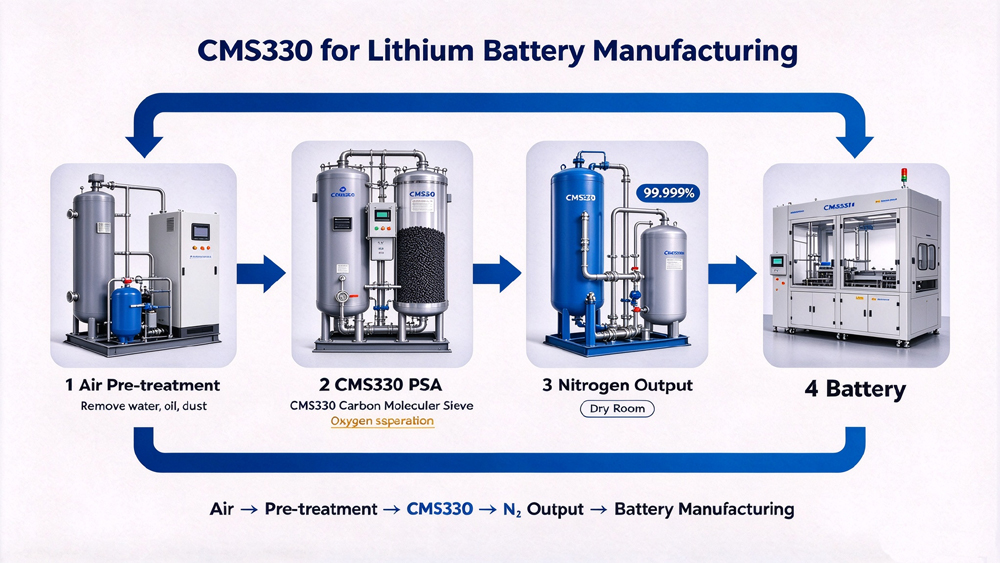
* Lithium battery manufacturing: Cathode sintering, anode thermal treatment, electrolyte filling and glove box protection, requiring stable nitrogen purity at 99.99% or even 99.999%. Lithium production lines run 24/7 continuously with strict control on nitrogen purity fluctuation. Lower air-to-nitrogen ratio of CMS330 can greatly reduce long-term power expense, making it a mainstream high-end option for lithium industry.
* Precision metal heat treatment: Bright heat treatment for stainless steel and special alloy to avoid surface oxidation and decarbonization, requiring stable high purity nitrogen ≥99.99%.
* SMT electronic reflow soldering: Shield gas for lead-free soldering to reduce solder oxidation and improve production yield with continuous stable high-purity nitrogen supply.
* Petrochemical inerting: Large storage tank and reactor emergency inerting with large flow high purity nitrogen for year-round continuous operation.
* Premium laser cutting: Thin stainless steel and aluminum precision cutting with nitrogen 99.99~99.999% to optimize cutting finish.
CMS330 selection recommendation: Select CMS330 if your system runs 24/7 continuously, long-term demand for nitrogen purity ≥99.99%, energy cost is high and you aim to cut compressor power consumption.
4. Performance Comparison & Material Selection Logic: CMS300 VS CMS330
Note: All data below are reference values under standard condition 0.7MPa, actual performance varies with site working conditions.
|
Item |
CMS300 |
CMS330 |
|
Positioning |
High performance general grade |
High performance grade for high purity nitrogen |
|
N2 productivity @99.5% (Nm3/h.t) |
300 |
330 |
|
N2 productivity @99.9% (Nm3/h.t) |
190 |
250 |
|
N2 productivity @99.99% (Nm3/h.t) |
120 |
165 |
|
N2 productivity @99.999% (Nm3/h.t) |
95 |
100 |
|
Air-to-nitrogen ratio @99.99% |
4.3 |
4.0 |
|
Single pellet crush strength |
>35N |
>35N |
|
Expected service life (Qualified air source) |
5~7 years |
6~8 years |
|
Advantage range |
99.5~99.99% N2, intermittent gas demand, cost balance |
99.9%~99.999% N2, 24h continuous operation, low energy consumption |
|
Limitation |
Nitrogen productivity at ultra-high purity is lower than CMS330 |
Higher purchase cost, strict requirement on compressed air pretreatment |
Many buyers simply assume higher model number means better performance and directly choose CMS330. Engineering evaluation should be considered:
* If nitrogen demand stays at 99.5% all year long, CMS300 is sufficient. The gain from CMS330 is limited, while higher material cost increases initial investment with poor ROI.
* For lithium and precision heat treatment plants running continuously at 99.99% high purity, the electricity saving brought by CMS330’s lower air-to-nitrogen ratio can offset the extra material cost over service life, delivering better total cost of ownership.
* Adequate compressed air pretreatment is a prerequisite for both grades. Oil contamination and liquid water cause irreversible micropore poisoning. Neither CMS300 nor CMS330 can reach rated performance with poor inlet air quality.
5. Key Operation Guidelines for Industrial End Users
* Filling procedure: Carbon molecular sieve must be packed densely and uniformly inside tower to prevent gas channeling. Loose filling causes pellet friction, powdering and gas bypass, resulting in fast nitrogen purity drop. Vibration compaction and top retaining mesh are necessary to guarantee service life.
* Compressed air pretreatment cannot be omitted: Pre-filters, activated carbon oil removal and dryer shall be equipped to guarantee inlet air dew point ≤ -40°C and zero residual oil. Oil contamination is irreversible and cannot be recovered.
* Start & stop operation: Rapid pressure relief and pressure shock accelerate pellet breakage. Large PSA nitrogen plants should adopt gentle start-stop control to avoid sudden pressure change.
* Sample test verification: For new projects, small-scale filling test is recommended to verify nitrogen output, purity and air consumption under actual site conditions. Benchmark data is only reference; tower geometry and cycle timing will change final performance.
* Aging and performance monitoring: CMS performance slowly declines over long operation. Regularly record nitrogen purity, compressor pressure and air consumption to assess material status and schedule replacement in advance to avoid unexpected production shutdown.
6. Market Application Summary
After years of industrial verification, CMS300 and CMS330 carbon molecular sieve have been widely deployed in lithium, heat treatment and SMT production lines globally, serving as reliable alternatives to imported carbon molecular sieve. CMS300 delivers stable balanced performance for medium-high purity and variable working conditions. CMS330 targets continuous high-purity applications, with core value of reducing long-term operation energy cost.
Carbon molecular sieve selection is not only comparing model numbers. Decision making should integrate target nitrogen purity, hourly gas consumption, running hours, air source condition, electricity price and project budget. We support PSA equipment manufacturers and end factories with sample testing, filling guidance and working condition assessment to select suitable CMS grade and avoid investment loss caused by improper selection.



 Tracy Chen