
Technical article
2026-05-29
4A molecular sieve, also known commercially as Zeolite 4A or Type A sodium zeolite, is a synthetic crystalline aluminosilicate with a uniform effective pore opening of approximately 4 angstroms (4 Å = 0.4 nm). The name "4A" derives from this precisely controlled micropore size, which allows the selective adsorption of molecules with a kinetic diameter smaller than 4 Å—most notably water (H₂O, ~2.8 Å), carbon dioxide (~3.3 Å), ammonia, hydrogen sulfide, methanol, ethanol, and small straight-chain hydrocarbons—while excluding larger molecules such as propane, branched hydrocarbons, and aromatics.
In industrial practice, 4A molecular sieve desiccant is the most widely used grade of molecular sieve adsorbent for deep dehydration of gases and liquids, natural gas dehydration, compressed air drying, insulating glass (IGU) units, pharmaceutical solvent drying, and as a phosphate-free detergent builder via ion exchange. Its combination of high water adsorption capacity (≥21–23 wt%), thermal regenerability, and competitive cost makes it the "general-purpose workhorse" among 3A, 4A, 5A, and 13X molecular sieves.
This comprehensive guide explores the crystal structure and chemistry of 4A zeolite, product forms and technical specifications, major industrial applications by sector, compatible operating environments and limits, regeneration procedures, and how to choose the right 4A molecular sieve bead or pellet for your process.
The sodium form of Type A zeolite is represented by the empirical formula:
Na₂O · Al₂O₃ · 2SiO₂ · 4.5H₂O (commonly written as Na₁₂[(AlO₂)₁₂(SiO₂)₁₂]·27H₂O in structural chemistry)
Key structural parameters:
SiO₂ / Al₂O₃ molar ratio: ≈ 2.0
Effective pore aperture: ~4.0–4.2 Å (8-membered oxygen ring)
Cavity (α-cage) diameter: ~11.4 Å
Crystal system: Cubic (Linde Type A – LTA)
CAS Number: 70955-01-0
4A molecular sieve is built from corner-sharing SiO₄ and AlO₄ tetrahedra that form a three-dimensional microporous network. Each aluminum atom introduces a negative charge into the framework, which is compensated by exchangeable Na⁺ cations located in the pore mouths and supercages. These Na⁺ ions can be ion-exchanged (e.g., with Ca²⁺ to make 5A, or K⁺ to make 3A).
The defining feature is the 8-membered ring window with a free aperture of ~4.12 Å. Only molecules whose kinetic diameter is ≤ 4 Å can enter the sodalite cage / α-cage system:
Adsorbed: H₂O (2.8 Å), CO₂ (3.3 Å), NH₃ (2.6 Å), H₂S (3.6 Å), SO₂, CH₃OH (3.6 Å), C₂H₅OH, C₂H₄, C₂H₆, O₂, N₂
Excluded: C₃H₈ (propane, ~4.3–4.5 Å), i-butane, benzene, toluene, branched isomers
This size-selective molecular sieving effect—not mere surface condensation—is why 4A outperforms silica gel or activated alumina for achieving ultra-low dew points (< -40 °C to -70 °C).
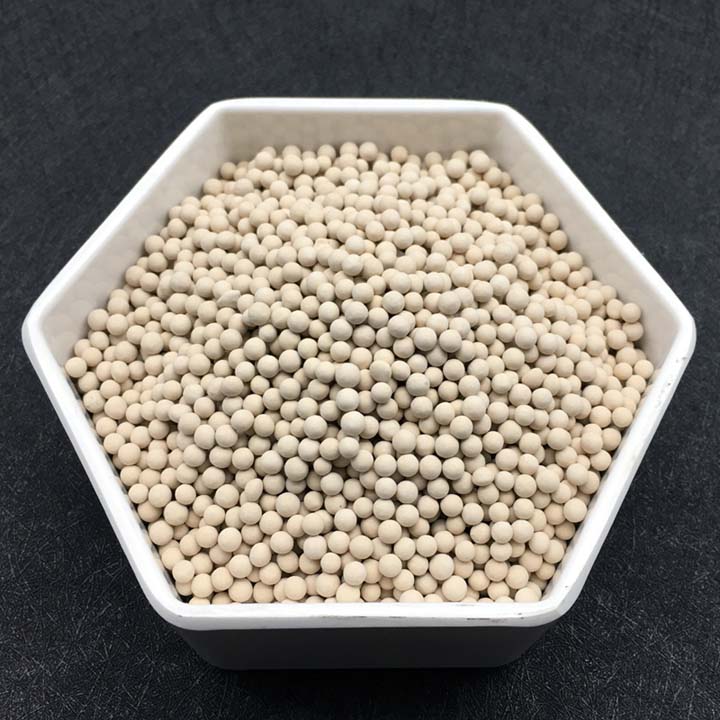
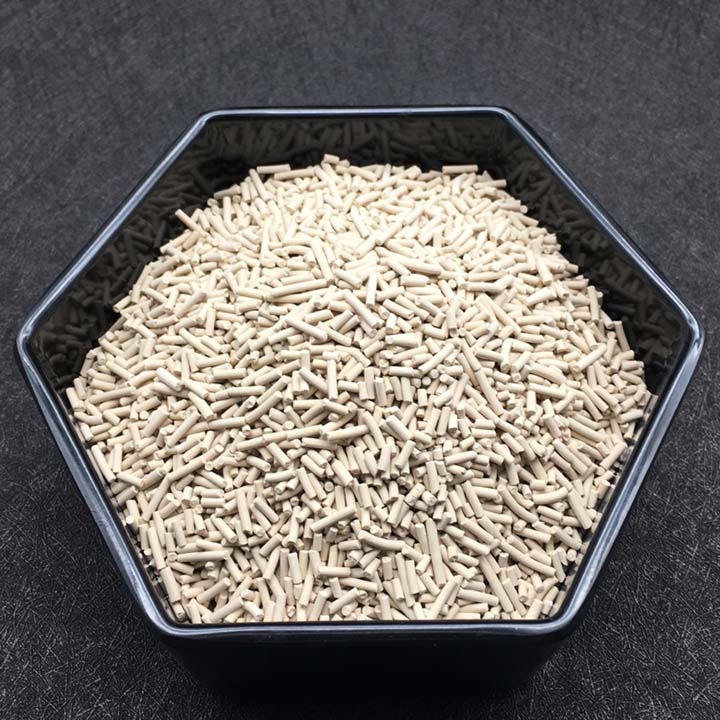
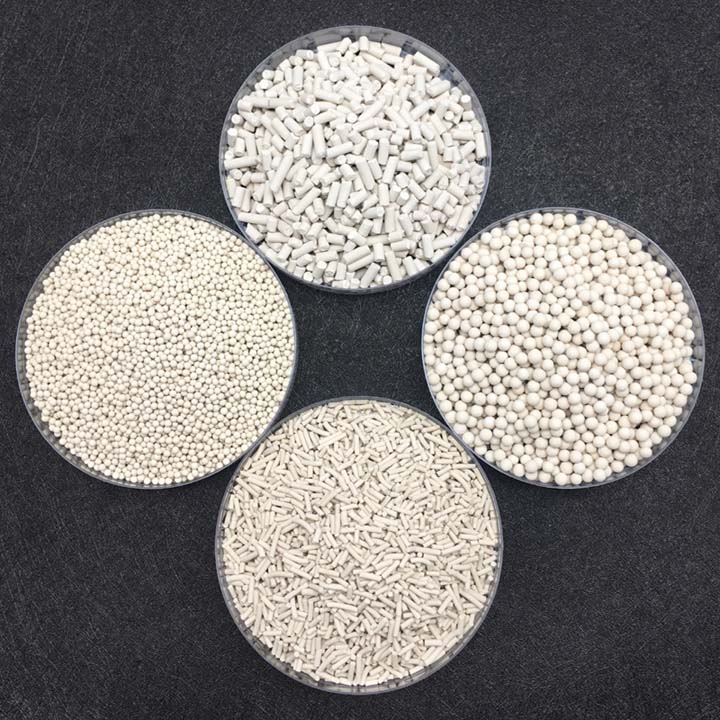
To match different process equipment (fixed-bed adsorbers, PSA towers, packed cartridges), 4A molecular sieve products are supplied in several physical forms:
|
Form |
Typical Size |
Advantage |
Typical Use |
|---|---|---|---|
|
Spherical beads |
1.6–2.5 mm (8×12 mesh), 3.0–5.0 mm (4×8 mesh) |
Low pressure drop, high crush strength, less dust |
Gas drying towers, compressed air dryers, natural gas dehydration |
|
Extruded pellets / rods |
1.6 mm, 3.2 mm diameter |
Higher bulk density, compact packing |
Large-volume fixed beds, liquid-phase dehydration |
|
Micropowder / Zeolite A powder |
< 5 μm |
High ion-exchange capacity, dispersibility |
Detergent formulations, catalyst supports, functional fillers |
|
Property |
Unit |
Value (Typical) |
|---|---|---|
|
Static water adsorption (25 °C, 50% RH) |
wt% |
≥ 21.5 – 23 |
|
Bulk density |
g/mL |
0.66 – 0.75 |
|
Crush strength (bead) |
N/bead |
≥ 30 (small), ≥ 60–80 (large) |
|
Attrition / abrasion loss |
wt% |
≤ 0.2 |
|
Loss on ignition (575 °C, 1 h) |
wt% |
≤ 1.5 |
|
Operating temperature |
°C |
≤ 90 (adsorption); 200–350 (regeneration) |
|
Dew point achievable |
°C |
-40 to -70 |
Values may vary slightly by manufacturer. Always request the COA/TDS.
One of the primary uses of 4A molecular sieve for gas dehydration is removing water vapor from natural gas streams to prevent hydrate plugging, corrosion, and meeting pipeline specifications (< 7 lb/MMscf or -20 °C dew point; LNG requires < 0.1 ppmv H₂O). Fixed-bed TSA (Temperature Swing Adsorption) units loaded with 4A spherical beads routinely achieve pressure dew points of -40 °C to -70 °C.
In compressed air and instrument air systems, heatless or heated PSA / TSA dryers use 4A molecular sieve to protect pneumatic controls, analyzers, and air-separation units from moisture-related fouling.
Pharmaceutical and fine-chemical processes require anhydrous solvents (ethanol, methanol, acetone, THF pre-dried) to avoid side reactions. Passing wet solvent through a 4A molecular sieve packed column or batch-adsorbing with activated 4A beads can raise ethanol from 95–96% to >99.5% absolute ethanol by removing bound water—a classic application of 4A molecular sieve for solvent dehydration.
Inside the spacer of insulating glass units (IGUs), 4A molecular sieve beads adsorb residual moisture and volatile organics from the sealed cavity, preventing interior fogging, pressure build-up, and seal failure. Its long-term stability under UV and temperature cycling makes it the industry-standard IGU desiccant.
Refrigeration and air-conditioning circuits install a filter-drier cartridge packed with 4A molecular sieve (sometimes blended with 3A for specific refrigerants) to trap moisture that would otherwise freeze at the expansion valve or hydrolyze HFC/HFO refrigerants. This extends system life and maintains efficiency.
Micron-sized Zeolite 4A powder exchanges Na⁺ for Ca²⁺ and Mg²⁺ ions in hard water, softening laundry wash water and enhancing surfactant performance. It has largely replaced sodium tripolyphosphate (STPP) in eco-friendly, phosphate-free detergent formulations, reducing eutrophication risk.
Long-tail: "Zeolite 4A as phosphate-free detergent builder replacing STPP", "calcium ion exchange capacity of 4A zeolite in laundry detergent"
Thanks to its ion-exchange sites, 4A zeolite can remove NH₄⁺-N (ammoniacal nitrogen) and heavy metals (Pb²⁺, Cd²⁺, Cu²⁺, Zn²⁺) from industrial effluents, serving as a low-cost, regenerable or disposable polishing media in tertiary wastewater treatment.
Small sachets or canisters of activated 4A beads are placed inside moisture-sensitive packaging (semiconductors, optical devices, APIs, dehydrated foods) to maintain a dry micro-environment during shipping and storage.
Temperature: Ambient to ~90 °C for adsorption phase (higher temps reduce capacity).
pH range (slurry/liquid contact): 4A powder is stable in neutral to alkaline media; dissolves slowly in strong acid.
Media: Suitable for both gas and liquid phases, provided the fluid is free of large particulates and immiscible oils that blind pores.
After saturation, the 4A bed is regenerated by:
Thermal Swing (TSA): Heating to 200–350 °C under a purge of dry air, N₂, or stripped gas for 3–6 hours.
Pressure Swing (PSA): Less common alone for 4A but used in combination; partial regeneration via depressurization.
Vacuum regeneration: 150–200 °C under vacuum accelerates moisture removal for sensitive processes.
Precautions: Avoid direct contact with liquid water in an unactivated state (may cause structural weakening or "clumping"); prevent oil/ hydrocarbon mist ingress which permanently reduces capacity.
Store unactivated or reactivated 4A molecular sieve in airtight, moisture-barrier packaging. Once opened, reseal promptly or re-activate before use. Shelf-life is indefinite if kept dry.
|
Type |
Pore Size |
Adsorbs |
Excludes |
Typical Application |
|---|---|---|---|---|
|
3A |
~3 Å |
H₂O only |
All organics incl. ethanol |
Ethanol dehydration, cracked gas drying (no polymerization risk) |
|
4A |
~4 Å |
H₂O, CO₂, H₂S, NH₃, MeOH, EtOH, small gases |
>C₃ hydrocarbons, aromatics |
General gas/liquid drying, natural gas dehydration, IGU, detergent |
|
5A |
~5 Å |
H₂O, n-paraffins (C₃–C₆), mercaptans |
Iso-paraffins, aromatics |
n-paraffin separation, PSA H₂ purification, sweetening |
|
13X |
~10 Å |
Larger organics, CO₂, H₂O, SO₂, VOCs |
Very large molecules |
Air pre-purification (CO₂ + H₂O removal) before cryogenic distillation |
Choosing 4A molecular sieve vs 3A for ethanol drying: 3A is preferred when you must avoid co-adsorbing ethanol; 4A will adsorb both water AND ethanol, which may be acceptable or even desirable in some batch processes but not in continuous fixed-bed absolute ethanol production.
When sourcing 4A molecular sieve beads or pellets, consider:
Application phase — Gas drying → spherical 4×8 or 8×12 mesh; liquid solvent → finer beads or pellets for better contact; detergent → micron powder.
Required dew point — Confirm static H₂O adsorption ≥ 21.5% and crush strength suited to bed depth/pressure.
Regeneration method — Higher attrition resistance needed for PSA cycling; TSA favors thermal stability.
Contaminants — If hydrocarbon co-adsorption is a concern, evaluate 4A vs specialty grades; pre-filter oily streams.
Certifications — Food/pharma contact may require FDA-compliant or low-heavy-metal certificates; detergent grade requires Ca²⁺ exchange capacity data (>300 mg CaCO₃/g).
Q1: Can 4A molecular sieve be reused?
Yes. Properly regenerated 4A molecular sieve can be cycled hundreds to thousands of times with minimal loss of capacity.
Q2: Why is 4A better than silica gel for deep drying?
Silica gel typically reaches ~-20 °C dew point; 4A molecular sieve routinely achieves -40 °C to -70 °C and works at higher temperatures with greater affinity for trace moisture.
Q3: Is 4A molecular sieve safe for food contact?
Activated 4A beads used as static desiccant in sealed sachets are generally recognized as safe (non-toxic, inert when dry). Check supplier documentation for food-grade compliance.
Q4: Can I use 4A to dry ethanol to 99.9%?
4A will remove water from ~96% ethanol but also adsorbs some ethanol. For true absolute ethanol without ethanol loss, a two-stage process (4A rough drying + 3A polishing or azeotropic distillation) is typical.
4A Molecular Sieve (Zeolite 4A) is a versatile, cost-effective, and thermally regenerable adsorbent engineered for deep moisture removal, selective small-molecule adsorption, and ion-exchange water softening. Its uniform 4 Å micropores, high specific surface area (>600–700 m²/g), and robust crystalline framework make it indispensable across oil & gas dehydration, compressed air systems, pharmaceutical solvent drying, insulating glass manufacturing, refrigerant circuit protection, and eco-friendly detergent formulation.
For buyers and engineers evaluating molecular sieve 4A vs silica gel vs 3A/5A, the decision hinges on required dew point, molecule size selectivity, regeneration capability, and process phase. When specified correctly—matching bead/pellet size, adsorption capacity, and regeneration protocol—4A zeolite molecular sieve delivers long service life and consistently ultra-dry process conditions, protecting downstream equipment and product quality.
If you are specifying 4A molecular sieve for gas dehydration plant design, insulating glass desiccant selection, or solvent drying in pharmaceutical API manufacture, consult your OIM's detailed TDS and request sample evaluation to confirm cycle performance under your actual operating environment.


 Tracy Chen