How to choose molecular sieves?
2026-11-13
Molecular sieves are crystalline aluminosilicate adsorbents with uniform, precisely defined pore structures. Unlike non-selective desiccants such as activated alumina or silica gel, molecular sieves operate on the principle of molecular sieving: molecules smaller than the pore opening enter the internal crystal cavities and are adsorbed, while molecules larger than the aperture are sterically excluded. This intrinsic selectivity is the core advantage of molecular sieves — it removes target impurities without capturing valuable process components, minimizing product loss, side reactions and batch rejection.
Silica gel and activated alumina mainly focus on bulk water uptake capacity. Molecular sieves are engineered for targeted selective adsorption. For deep purification where impurity selectivity is critical, molecular sieves are the preferred adsorbent.
1. Main Type Table
|
Type |
Pore diameter |
Key adsorption substance |
Repulsive substance |
Typical operating conditions |
|
3A |
3A |
H2O |
Ethylene、Propylyne、Ethanol、Methanol etc |
Olefin cracking gas drying, ethanol/methanol dehydration, refrigerant drying; Only removes water, does not adsorb olefins/alcohols, to prevent material loss |
|
4A |
4A |
H2O、CO2、H2S、Methanol |
Propane and higher molecular weight hydrocarbons |
Compressed air drying, ordinary natural gas dehydration, refrigerant and solvent drying, universal deep drying |
|
5A |
5A |
H2O、CO2、H2S、Alkanes |
Branched chain alkanes and aromatic hydrocarbons |
Separation of isomeric hydrocarbons, hydrogen purification, PSA hydrogen production, natural gas dehydration and decarbonization |
|
13X |
10A |
H2O、CO2、H2S、Parts of hydrocarbons |
Large molecule aromatic hydrocarbons |
Pre purification of air separation unit, PSA oxygen production, decarbonization and desulfurization of natural gas, biogas purification, carbon dioxide capture |
|
CMS |
4A |
O2 |
N2 |
PSA N2 generators |
Core selection rule: Select the smallest pore size that allows the impurity molecule to enter while rejecting the product stream. Over-sized pores will co-adsorb valuable feed components, consume adsorption capacity and increase regeneration energy consumption. Undersized pores prevent impurity uptake and fail outlet specification requirements.
2. Process Data Checklist Before Purchase
Most adsorption failures stem from grade mismatch rather than poor adsorbent quality. Prepare the following parameters before requesting a quotation:
1) Fluid phase: Is gas (natural gas, compressed air, cracker gas, biogas) or liquid (alcohols, glycols, refrigerants); full component list, including COS, heavy hydrocarbons, aromatics and oil mist?
2) Purification target: water removal only? Combined CO2/ H2S removal? Required outlet dew point or impurity ppm specification.
3) Operating conditions: Working pressure, inlet temperature, volumetric flow rate, inlet loading of water and sulfur compounds?
4) Adsorption cycle: TSA (Temperature Swing Adsorption) or PSA (Pressure Swing Adsorption); adsorption cycle time, regeneration temperature, purge gas media?
5) Physical form requirement: pellet / bead; particle size (1.6–2.5 mm/3.0–5.0 mm); requirements for crush strength, low dust generation?
3. Key Acceptance Indicators for Purchase
Prices vary widely within the same grade. Performance differences are defined by these measurable technical indexes:
· Static water adsorption capacity: Fundamental loading capacity, determines bed volume and service interval.
· Crush strength: Low crush strength leads to attrition, bed powdering, differential pressure rise and carry-over in towers.
· Attrition loss: Critical dust index for air separation and PSA systems, where fine particles damage valves and filters.
· Residual moisture: Pre-activation at factory increase adsorption capacity before deliver.
· Packaging: Molecular sieves hydrate rapidly upon ambient air exposure; vacuum / aluminum foil hermetic packaging is mandatory for storage.
Technical note: Molecular sieve adsorption is a reversible physical process. Standard molecular sieve 3A / 4A / 5A / 13X can be regenerated at 200–350 °C for repeated cycles. Irreversible poisoning occurs when heavy hydrocarbons, lube oil or polymer precursors enter the pore network, permanently blocking cavities. This cannot be restored by thermal regeneration, so upstream coalescing filtration is required for oil-contaminated feeds.
4. Fast Application Matching
· Ethylene / propylene / olefin cracker gas drying → molecular sieve 3A (priority grade to prevent olefin co-adsorption)
· Ethanol / isopropanol dehydration → molecular sieve 3A
· Compressed air deep drying → molecular sieve 4A
· Air separation pre-treatment (H2O + CO₂ removal) → molecular sieve 13X
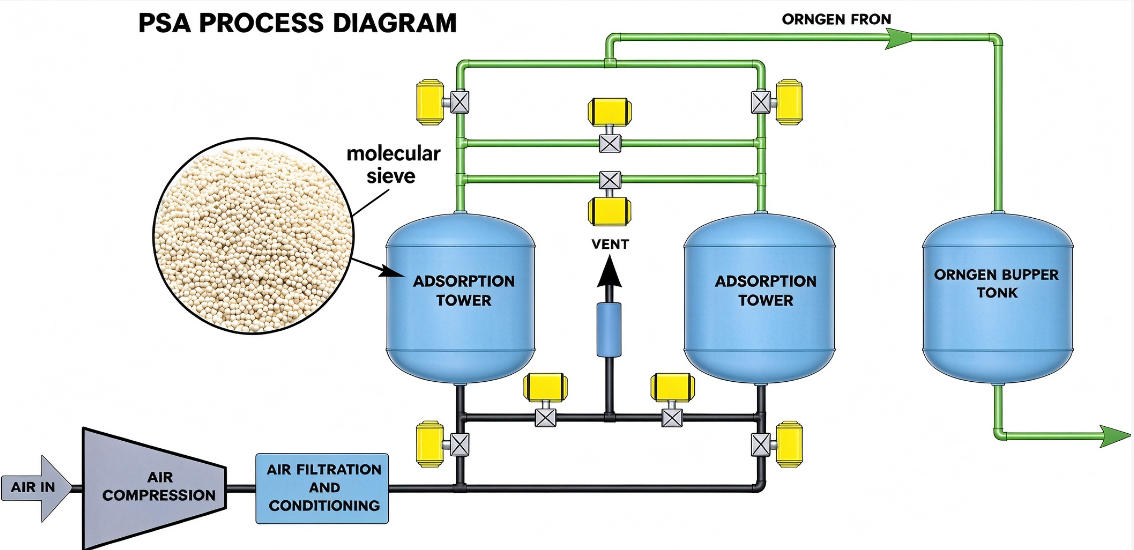
· PSA oxygen production → Sodium type 13X molecular sieve or lithium molecular sieve
· PSA nitrogen production → CMS carbon molecular sieve
· Natural gas combined dehydration, decarbonation and desulfurization → molecular sieve 13X; dehydration-only service can use molecular sieve 4A
· N-paraffin separation & hydrogen purification → molecular sieve 5A
5. Common RFQ
Q1: Higher adsorption capacity is always better.
A1: Capacity is secondary to selectivity. For olefin drying, molecular sieve 4A will adsorb ethylene and propylene. Even with excellent water capacity, it causes yield loss and higher operating cost.
Q2: Molecular sieve and activated alumina are interchangeable.
A2: Activated alumina is suitable for bulk pre-drying. Molecular sieves deliver ultra-deep dew points below -60 °C. A layered bed (activated alumina upstream + molecular sieve downstream) is widely adopted to reduce sieve loading and extend service life.
Q3: Place the adsorbents as they arrive, load them anytime.
A3: Once opened, adsorption starts immediately. Charge the tower as soon as possible after opening, and re-seal unused material hermetically.
6. Advanced Technical Supplement
Adsorption Thermodynamics & Isotherm Characteristic
Molecular sieve adsorption is exothermic. Higher operating temperature reduces equilibrium adsorption capacity; higher partial pressure of target impurity increases loading. The isotherm curve of molecular sieve rises sharply at low water partial pressure, which explains its outstanding performance for ultra-low dew point purification. This distinguishes it from silica gel and alumina, whose isotherms flatten at low partial pressure.
Mass Transfer Zone (MTZ) in Fixed Bed
In a packed adsorption tower, adsorption does not occur across the entire bed simultaneously. A moving mass transfer zone forms along the gas flow direction. A sieve with uniform particle size and low attrition delivers a narrower MTZ, making full use of the bed volume and delaying breakthrough. Non-uniform packing or excessive fines broaden the MTZ and cause premature breakthrough.
Regeneration Mechanism
For TSA: heat supply raises vapor pressure of adsorbed molecules to desorb them, followed by cool-down under dry purge. The upper limit of regeneration temperature must avoid framework collapse. High-silica types have better thermal stability. For PSA: desorption relies on pressure reduction. Lower purge pressure gives higher residual desorption efficiency, but increases vacuum or blowdown energy consumption.
Hydrothermal Stability
Repeated high-temperature regeneration in the presence of water vapor may gradually degrade the crystal framework. High-quality molecular sieve features superior hydrothermal stability, resisting dealumination and capacity decay over thousands of cycles. This is a hidden long-term cost factor that is rarely shown on basic data sheets.
Framework Structure & Cation Exchange Effect
Molecular sieves are built from TO₄ tetrahedra (T=Si, Al). The negative charge generated by Al substitution is balanced by exchangeable cations (Na⁺, K⁺, Ca²⁺). Cation type directly controls effective pore opening, polarity and adsorption affinity. This is the core reason why two suppliers selling the same nominal grade can show completely different dynamic performance. For example, potassium substitution converts 4A into 3A sieve; calcium exchanged 4A becomes 5A. Cation distribution uniformity also affects resistance to competitive adsorption.
Co-adsorption & Competitive Adsorption Effect
In multi-component streams such as raw natural gas and biogas, water, H₂S and CO₂ compete for the same active adsorption sites. Water normally exhibits stronger adsorption affinity than CO2 and H2S. When water loads are high, the sieve’s capacity for acid gases will drop significantly. This competitive effect must be considered when designing combined dehydration and sweetening units, which is why upstream bulk water removal is often recommended before H2S / CO2 removal.
7. Our Capability as a Professional Adsorbent Manufacturer
We produce a full series of adsorbents: 3A, 4A, 5A, 13X molecular sieves, CMS carbon molecular sieve, activated alumina and silica gel. We support standard stock and custom formulation for special operating conditions.
· Free process evaluation and grade recommendation based on your feed composition, pressure and outlet specification.
· Sample supply and third-party test certificates available; export-compliant packaging for global orders.
· Application coverage: natural gas, air separation, petrochemical, new energy, gas equipment and environmental CO₂ capture.
· On-site packing guidance, regeneration parameter tuning and troubleshooting for high differential pressure, powdering and dew point excursion.
If you are evaluating adsorbent replacement, comparing suppliers or sizing a new adsorption tower, send your process parameters to us. We will provide a tailored technical proposal and quotation.



 Tracy Chen