3A Molecular Sieve: Complete Guide
2026-04-22
3A molecular sieve, also named
3A zeolite molecular sieve, is a kind of potassium-modified synthetic crystalline aluminosilicate zeolite adsorbent, belonging to type A molecular sieve series with precise 3 Angstrom (0.3nm) effective pore diameter. As the most widely used industrial selective desiccant in petrochemical, glass, chemical solvent, natural gas and refrigerant industries,
3A molecular sieve realizes exclusive water molecule adsorption while completely excluding larger hydrocarbon, olefin and organic molecules. It solves the problem of deep dehydration without side reaction, polymerization or component loss, and has become an irreplaceable core adsorbent in modern industrial drying processes. This article comprehensively introduces the basic properties, adsorption mechanism, technical specifications, multi-industry applications, regeneration technology, performance advantages, selection methods and manufacturer advantages of 3A molecular sieve.
1. Basic Definition & Chemical Composition of 3A Molecular Sieve
3A molecular sieve is derived from sodium type 4A molecular sieve, through potassium ion exchange modification, replacing part of Na⁺ with larger K⁺ ions, which reduces the effective pore size from 4Å to strictly controlled 3Å (0.3nm). It is alkali metal potassium sodium aluminosilicate with regular three-dimensional cage crystal pore structure.
Standard chemical formula of industrial grade
3A molecular sieve:
2/3K2O⋅1/3Na2O⋅Al2O3⋅2SiO2⋅9/2H2O
Silicon-aluminum ratio: SiO₂/Al₂O₃≈2, typical crystal structure type A, uniform pore distribution, huge specific surface area and strong polar adsorption capacity for water molecules.
The core characteristic of 3A zeolite molecular sieve is strict molecular size screening effect: only molecules with kinetic diameter less than 3Å can enter internal pores and be adsorbed; molecules larger than 3Å are completely blocked outside the pore channel and cannot be adsorbed at all. Water molecule kinetic diameter is 2.6Å, which perfectly matches 3Å pore size; while ethylene (4.2Å), propylene (4.8Å), ethane, methane, carbon dioxide and other hydrocarbon molecules are larger than 3Å, so they will not be adsorbed by 3A molecular sieve. This unique selective performance distinguishes it from ordinary silica gel, activated alumina and other non-selective desiccants.
2. Working Principle & Adsorption Mechanism of 3A Molecular Sieve
2.1 Size Selective Screening Principle
The core working principle of 3A molecular sieve desiccant is steric hindrance size selective adsorption:
-
Effective pore diameter: fixed 3Å, uniform distribution, no abnormal large pores;
-
Adsorbable molecules: H₂O (2.6Å), NH₃, methanol small polar molecules;
-
Completely excluded molecules: ethylene, propylene, butadiene, LPG, natural gas hydrocarbons, ethanol macromolecules, acetylene, CO₂, etc.
In olefin drying process, ordinary desiccant will adsorb olefin while adsorbing water, leading to polymerization, coking and equipment blockage; but 3A molecular sieve for ethylene drying only removes water, completely retains olefin components, greatly improving process safety and product yield.
2.2 Polar Electrostatic Adsorption Mechanism
3A molecular sieve crystal framework is negatively charged, combined with K⁺ and Na⁺ cations, forming strong electrostatic field inside pores. Water is strong polar molecule, which produces strong physical adsorption force with internal pore surface of 3A molecular sieve, achieving deep dehydration. The adsorption heat of water is about 3780KJ/Kg, with fast adsorption speed and low residual moisture after adsorption.
Dynamic adsorption performance: under normal temperature and pressure, 3A molecular sieve can reduce gas/liquid moisture content to below 10ppm, realizing industrial ultra-deep drying, which cannot be achieved by traditional distillation and ordinary desiccants.
3. Standard Technical Specifications & Physical Properties of Industrial 3A Molecular Sieve
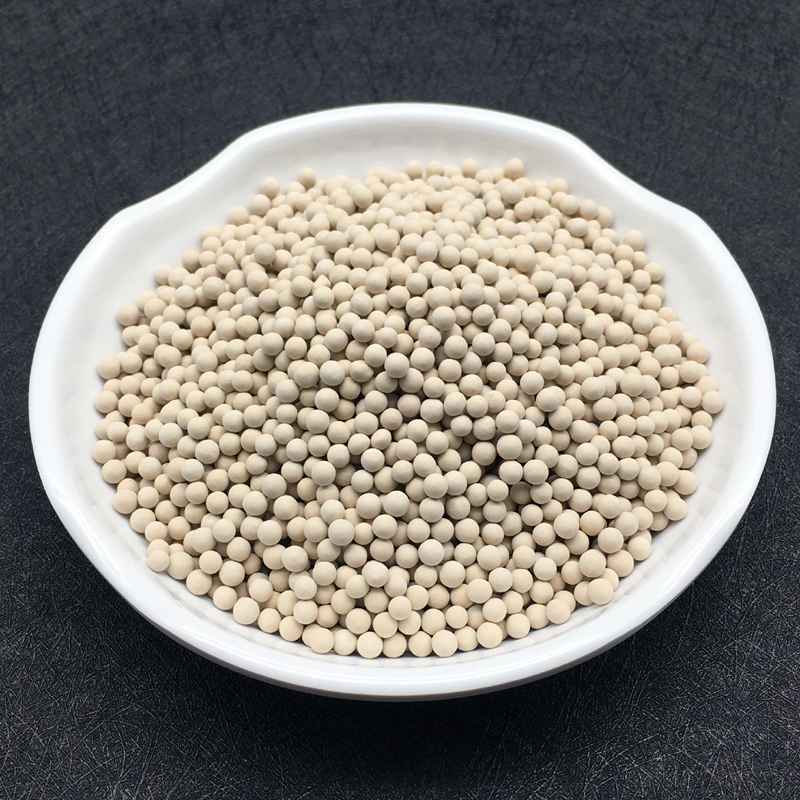
Industrial mainstream products include 3A molecular sieve beads & pellets, common specifications 1/16"(1.5–1.8mm), 1/8"(3.0–3.3mm), 4×8 mesh, 8×12 mesh, detailed standard parameters as follows:
|
Performance Item |
Standard Index Value |
|
Effective pore size |
3Å (0.3nm) |
|
Static water adsorption capacity |
≥20.0 wt% (25℃, RH60%) |
|
Bulk density |
0.60–0.70 g/ml |
|
Crush strength |
≥30N/pellet (small beads), ≥60N/pellet (large beads) |
|
Attrition loss |
≤0.25 wt% |
|
Residual moisture (activated) |
≤1.0 wt% |
|
Temperature resistance |
-20℃ to 600℃ |
|
Shape |
Spherical beads / cylindrical pellets |
High quality China manufacturer 3A molecular sieve has uniform particle size, low dust, high mechanical strength, stable pore structure, long service life and multiple renewable times, which can meet continuous industrial production requirements.
4. Core Competitive Advantages of 3A Molecular Sieve vs Other Desiccants
Compared with activated alumina, silica gel, 4A/5A molecular sieve, industrial grade 3A molecular sieve has obvious advantages:
-
Ultra-high selectivity: only adsorb water, never adsorb olefin/hydrocarbon, avoid polymerization side reaction, suitable for unsaturated hydrocarbon drying;
-
Deep dehydration performance: residual moisture ≤10ppm, far better than ordinary desiccants;
-
Fast adsorption speed, large adsorption capacity, low regeneration energy consumption;
-
High mechanical strength, anti-crushing, low dust, long service life;
-
Stable chemical performance, acid and alkali resistance, not easy to poison;
-
Renewable repeatedly, low comprehensive operation cost;
-
Automatic production system matching, easy to realize continuous drying process.
Key advantage: It is the only professional desiccant for ethylene, propylene, butadiene and other reactive unsaturated hydrocarbon drying in petrochemical industry, irreplaceable by other adsorbents.
5. Multi-dimensional Industry Applications of 3A Molecular Sieve
5.1 Petrochemical Industry: 3A Molecular Sieve for Ethylene, Propylene & Cracked Gas Drying
3A molecular sieve for ethylene drying, 3A molecular sieve for propylene drying, 3A molecular sieve for butadiene drying are the largest application fields. In ethylene/propylene low-temperature separation units, water vapor will form hydrate ice blockage at low temperature; ordinary desiccant adsorbs olefin to cause polymerization coking. 3A molecular sieve selectively removes water only, protects olefin activity, ensures stable operation of cracking gas separation units, and is widely used in refinery cracked gas, natural gas processing plant.
5.2 Chemical Solvent Industry: 3A Molecular Sieve for Ethanol Dehydration & Absolute Alcohol Production
3A molecular sieve for ethanol dehydration is the core process to produce 99.5%+ absolute ethanol. Traditional distillation cannot break ethanol-water azeotrope; 3A molecular sieve adsorbs water from azeotropic ethanol vapor, efficiently produces anhydrous ethanol, widely used in bioethanol, pharmaceutical solvent, chemical reagent, alcohol fuel industry. Also applicable to methanol, acetone and other polar solvent deep dehydration.
5.3 Insulating Glass Industry: 3A Molecular Sieve for Insulating Glass Units
3A molecular sieve for insulating glass is special static desiccant for double hollow glass. It adsorbs internal air moisture permanently, prevents glass fogging, condensation and mildew, maintains hollow glass thermal insulation and sound insulation performance. It does not adsorb air nitrogen/oxygen, only adsorbs water, which is the standard matching desiccant for building hollow glass worldwide.
5.4 Natural Gas & LPG Industry: 3A Molecular Sieve for Natural Gas Drying
Used for natural gas, liquefied petroleum gas (LPG) dehydration, prevent pipeline hydrate corrosion and freezing blockage, meet natural gas pipeline transportation standard moisture requirements.
5.5 Refrigerant & Air Conditioning Industry
Special drying desiccant for refrigerants R134a, R22, R410a, removes trace water in refrigerant, prevents compressor ice blockage and corrosion, improves service life of refrigeration equipment.
5.6 Other Industries
Pharmaceutical intermediate drying, compressed air deep drying, industrial gas purification, packaging moisture-proof drying, etc.
6. 3A Molecular Sieve Regeneration Method & Operation Maintenance Guide
3A molecular sieve regeneration method is adsorption saturation 3A molecular sieve can be regenerated by heating purging, reusable for many times:
-
Regeneration temperature: 180–250℃;
-
Regeneration medium: dry nitrogen or dry air purging;
-
Regeneration time: 2–4 hours;
-
After cooling, it can be put into adsorption work again.
Normal service life: 2–3 years under reasonable operation; avoid liquid water immersion, acid-base corrosion and high temperature exceeding 600℃ during storage and use. Storage requirements: sealed dry environment, relative humidity ≤90%, avoid open air moisture absorption.
7. Difference Between 3A vs 4A Molecular Sieve
3A vs 4A molecular sieve difference, detailed comparison:
-
3A molecular sieve: 3Å pore, potassium type, only adsorb water, no olefin adsorption, special for unsaturated hydrocarbon/ethanol/insulating glass drying;
-
4A molecular sieve: 4Å pore, sodium type, adsorb water + ethanol + ammonia, cannot be used for ethylene/propylene drying.
3A is upgraded selective product based on 4A, with higher application specificity and higher market value.
8. How to Choose High Quality 3A Molecular Sieve & Manufacturer Advantages
When purchasing high quality 3A molecular sieve manufacturer China, You should check: static water adsorption capacity, pore uniformity, crush strength, dust content, regeneration stability, batch consistency. Chinese professional molecular sieve factories have stable quality, competitive bulk price, complete specifications beads/pellets, support custom activation and packaging, provide OEM/ODM and global export service, OIM are preferred suppliers for overseas petrochemical, glass and chemical enterprises.
9. FAQ
What is 3A molecular sieve used for?
Mainly for selective deep dehydration of water, especially ethylene, propylene, ethanol, insulating glass drying.
Can 3A molecular sieve adsorb ethylene?
No, ethylene diameter >3Å, completely excluded.
How much water can 3A molecular sieve adsorb?
Static adsorption ≥20wt%.
How to regenerate 3A molecular sieve?
Heat at 180–250℃ with dry gas purging.
3A vs insulating glass molecular sieve?
Special 3A grade is standard for insulating glass.
Conclusion
3A molecular sieve (3A zeolite molecular sieve) is a high-performance selective industrial desiccant with precise 3Å pore size, exclusive water adsorption performance, stable physical and chemical properties and wide multi-industry applications. It is irreplaceable in petrochemical olefin drying, ethanol absolute dehydration, insulating glass moisture removal, natural gas purification and other fields.



 Tracy Chen