13X Molecular Sieve for LPG Purification
2026-11-23
Liquefied Petroleum Gas (LPG) mainly consists of propane and butane. Crude LPG from refinery or gas field contains water, hydrogen sulfide and mercaptans. Moisture causes hydrate blockage and pipeline corrosion; sulfur compounds lead to corrosion, odor and excessive sulfur emission during combustion. 13X molecular sieve is the key adsorbent for one-step purification of LPG, capable of simultaneous dehydration, H₂S removal and mercaptan removal, which cannot be achieved by 3A / 4A / 5A molecular sieve.
Main Applications
1. Deep dehydration: Remove trace water, lower dew point and prevent ice blockage in low-temperature pipeline, protect compressors and storage tanks.
2. H₂S adsorption: Reduce corrosive hydrogen sulfide content.
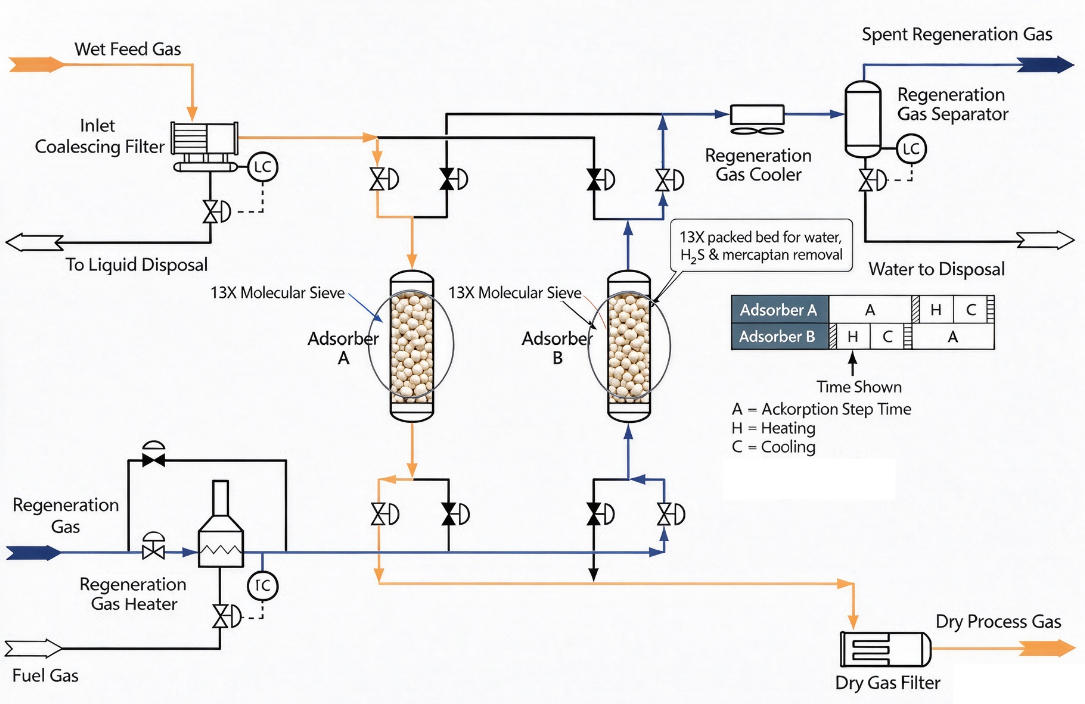
3. Mercaptan removal (sweetening): The biggest advantage of molecular sieve 13X. Its 10Å pore opening allows mercaptan molecules to enter inner pores for capture, so as to meet total sulfur and copper strip corrosion standard. The typical process is twin-column switching: one bed for online adsorption, the other for hot gas regeneration & cooling.
Many LPG producers and distributors face frequent issues such as unsatisfactory copper corrosion test and inspection hold-up for export cargo. Traditional Merox sweetening generates hazardous spent caustic waste and risks caustic carry-over into finished LPG. Molecular sieve 13X adsorption enables integrated removal of water, H₂S and mercaptans in one fixed bed. It helps customers simplify process layout, cut hazardous waste output and consistently meet quality requirements for export LPG.
Under stable operating conditions with clean feedstock, 13X molecular sieve delivers reliable deep purification performance: it can reduce water content in LPG to ≤5 ppmw, H₂S to ≤1 ppmw, and mercaptan sulfur down to 3–5 ppmw, supporting negative test and acceptable copper strip corrosion to meet the specification for export-grade LPG.
At the same time, this TSA adsorption process is mature and stable in operation, with a long service life of the packing material. As long as the feed gum and heavy components are controlled properly, the molecular sieve can be repeatedly regenerated and used. In the long run, it can reduce the cost of continuous consumables replacement and operation for customers, and is suitable for stable and continuous LPG production and sales projects.
Working Principle
13X (NaX) is sodium aluminosilicate zeolite with uniform pore size ~10Å. The adsorption is physical adsorption driven by polarity & van der Waals force, no chemical reaction occurs.
* Screening effect: Polar small molecules with molecular dynamics diameters less than 10 Å (H ₂ O 2.75 Å, H ₂ S 3.6 Å, methyl mercaptan 4.2 Å) can enter the internal pore cage of the molecular sieve; Although propane and butane hydrocarbon molecules can also enter the pores in size, their polarity is weak and their adsorption affinity is much lower than that of water and sulfides. They are more likely to desorb and flow out during regeneration, achieving selective separation.
* Polarity priority adsorption: Water, hydrogen sulfide, and thiol are all strongly polar molecules that are firmly captured by the strong electric field in the 13X pore; Non polar propane butane only weakly adsorbs, and most of it flows out directly through the adsorption bed to obtain purified LPG products.
* Regeneration principle: After adsorption saturation, the bed temperature is increased, the partial pressure is reduced, and the electrostatic adsorption force is broken. Water, H2S, and thiols are desorbed from the pores and carried away by the blowing gas; After cooling, the adsorption capacity of 13X is restored, and it can be recycled for long-term use.Note: If only dehydration is required without mercaptan, 3A molecular sieve is more suitable, with less hydrocarbon co-adsorption and lower regeneration cost. 13X is selected mainly for LPG sweetening.
Zeolite 13X is not the optimal choice for simple dehydration; If LPG only needs dehydration and does not contain thiols, 3A molecular sieve is preferred in engineering, resulting in less hydrocarbon co adsorption and lower regeneration energy consumption. 13X molecular sieve is preferred only for LPG refining conditions that require simultaneous mercaptan removal.
Summary of molecular sieve Advantages
* Single bed layer synchronously completes dehydration, hydrogen sulfide removal, and mercaptan removal, simplifies the process flow, and reduces equipment investment;
* High adsorption capacity and fast mass transfer rate, suitable for liquid-phase LPG fixed bed adsorption devices;
* Renewable and reusable, stable operation;
* Compared to alkaline washing process, it has less solid waste and is more suitable for refineries and LPG export projects with strict environmental control.
Jiangxi OIM Chemical supplies high-performance 13X molecular sieve for LPG service, as well as 3A,4A,5A molecular sieve, activated alumina, inert ceramic balls and tower packings. Our adsorbents serve LPG, natural gas, PSA nitrogen, compressed air drying and hydrocarbon separation. Samples and bulk supply available for global customers.



 Tracy Chen